9Router Antigravity support means Antigravity joins 9Router as one of its five subscription providers — the router reuses your existing Google Antigravity OAuth session as a model source, so Antigravity's models sit in your routed pool alongside your Claude Code, Codex, GitHub Copilot and Cursor sessions, all behind one local endpoint.
📺 Watch: 9Router: New FREE Unlimited AI Coder!
🔥 Get the Agent OS as a free bonus: AI Profit Boardroom members get the full Agent OS zip, prompt libraries, daily tutorials and weekly live coaching calls. → Get inside
That is the entire relationship in one line. Antigravity feeds models in. 9Router hands them out. You end up with one URL, one Bearer token, and the coding sessions you already hold pooled behind a single door.
Everything below comes from the decolua/9router GitHub README, checked September 2026, plus what Julian found on his own install — and where a number is Julian's count rather than the README's, it says so. For the router itself in full, start with the main 9Router review. One naming note before we go: 9Router also appears as NymRouter — Nine Router — so if you see both names floating around, it is the same project.
What 9Router Antigravity Routing Actually Gives You
Google Antigravity is Google's agentic IDE — an agent-first coding editor. If you use it, you already hold a Google OAuth session with model access attached to it. 9Router treats that session as a provider, exactly the way it treats a Claude Code login or a GitHub Copilot seat.
The README documents five subscription providers in total: Claude Code, Codex, GitHub Copilot, Cursor and Antigravity. Connect them and 9Router spreads work across the lot. Your Antigravity access stops being locked inside one editor and becomes one more source in a shared pool that any OpenAI-compatible tool can draw from.
Scale is the real argument. The README lists 40+ providers and 100+ models; Julian's install counted 573+ models across those 40+ providers — his own dashboard number, noticeably higher than the README's published list. Both numbers point the same direction: Antigravity is one slice of a much bigger pool, and that is the point. No single provider has to carry your whole day.
Coming at this from the Antigravity side first? The Antigravity vibe-coding guide covers working in the IDE itself, and the Antigravity + Remotion workflow shows it driving programmatic video renders.
How the Antigravity Provider Connection Works
9Router is free, MIT-licensed, open source, and runs entirely on your machine. Setup is two commands. Install globally with:
npm install -g 9router
Then start it with:
9router
The dashboard opens at http://localhost:20128. That dashboard is where providers get connected — and for Antigravity, connecting means reusing the OAuth session you already created by signing into Google's IDE. No new API key. No separate billing relationship. The README's whole model is that sessions you already hold become routes.
Once connected, everything serves through one OpenAI-compatible endpoint at http://localhost:20128/v1, with chat completions at /v1/chat/completions. Authentication is a Bearer token you copy straight from the dashboard. One URL, one token, whole pool.
The full step-by-step lives in the 9Router install guide, and the how to use 9Router companion covers daily driving once it is up and running.
This is exactly the kind of plumbing members wire up inside AI Profit Boardroom — routers, agents and already-held sessions assembled into systems that ship real work, instead of stacks that sit idle looking clever.
Where Antigravity Sits in the Fallback Chain
9Router's routing logic is what the README calls Smart 3-Tier Fallback: Subscription tier first, then Cheap, then Free. When a provider hits quota or starts erroring, the router switches automatically, so requests keep flowing instead of stalling mid-session.
Antigravity sits in tier one — the subscription tier — alongside Claude Code, Codex, GitHub Copilot and Cursor. Below that, 20+ API-key providers form the cheap tier, and three free-tier providers — Kiro, OpenCode Free and Vertex AI — form the floor.
The practical effect: your Antigravity session gets used while it has headroom. When it runs dry, the router moves to the next source without you touching a setting. That is the difference between five separate sessions you babysit manually and one pooled quota that manages itself.
📺 Watch: Antigravity + Agent OS is INSANE 🤯
Endpoint Notes and the RTK Token Saver
Because the endpoint speaks the OpenAI format, any tool that speaks it too can consume the routed pool — more on which tools are actually documented in a moment. 9Router also ships one optimisation worth knowing about before you push agent traffic through it.
The RTK Token Saver compresses bulky tool outputs — git diff, grep, ls and tree results — before they reach the model, for roughly 20-40% input-token savings by the README's figures. It is on by default. Want a specific request left untouched? Send the header X-9Router-Token-Saver: off and that call passes through uncompressed.
Agentic coding sessions are precisely the workloads that dump directory trees and diffs into context on every step, so the compression compounds. Pooled quota plus smaller requests means each provider session — Antigravity's included — stretches further than it would alone.
📺 Watch: Build Anything with Antigravity CLI, Here’s how!
Provider, Not Consumer: The Distinction That Matters
Get this right, because it decides how you build. The decolua/9router README documents Antigravity as a provider only — a subscription session the router draws models from. It does not document pointing the Antigravity IDE at 9Router's endpoint as a consumer.
The tools documented on the consumer side are Claude Code, Codex, Cursor and OpenClaw. If you want a coding agent drinking from the routed pool, that is the supported list — the 9Router Claude Code wiring guide walks through the flagship example.
So the honest picture: Antigravity gives to the pool; Claude Code and the other documented consumers take from it. If someone tells you to paste the localhost URL into Antigravity's own settings, they are describing a setup the README does not back. Check decolua/9router on GitHub yourself if the docs have moved since September 2026 — but build on what is documented, not on what sounds plausible.
Warnings and Limits Straight From the README
The README is unusually blunt about its own edges, and the warnings are worth repeating with attribution because they shape the pool your Antigravity session joins:
- Kiro's free tier sits around 50 credits a month — a trickle, not a firehose, so treat it as emergency capacity.
- The OpenCode Free model list fluctuates, so never build a workflow that assumes a specific free model will exist tomorrow.
- iFlow, Qwen Code and Gemini CLI free tiers were discontinued in 2026 — dead routes the project has already pruned from the map.
- Dashboard cost figures are estimates only. The router itself never charges you; any spend comes from your own provider accounts on their own terms.
None of these warnings touch the Antigravity provider directly. They matter anyway, because the free tier underneath your subscription tier is thinner than the provider count suggests — which makes a strong tier one, with Antigravity in it, more valuable rather than less.
Who Should Bother — and Who Should Not
Worth it: you hold an Antigravity session plus at least one other subscription provider — Claude Code, GitHub Copilot, Cursor or Codex — and you run agentic workloads that chew through quota. Pooling them behind 9Router turns idle capacity into routed capacity for the cost of two commands and an OAuth reuse.
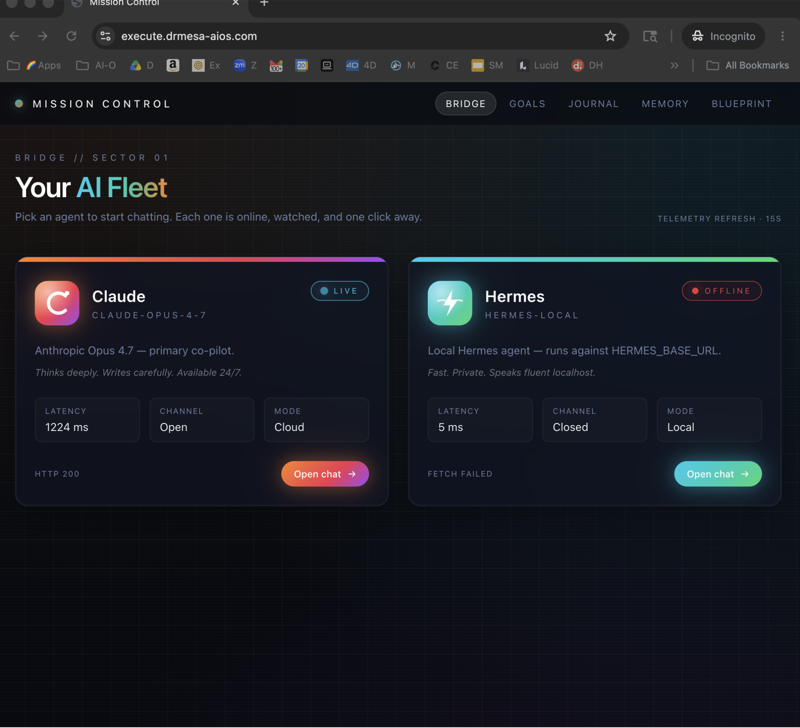
Also worth it if you want redundancy at the router layer itself. In Julian's Agent OS setup — the free agent stack from the Agent OS guide — the free-coder tab has a dropdown where 9Router sits alongside OmniRoute, a two-router pattern so no single router becomes a single point of failure. The 9Router vs OmniRoute comparison breaks down when to reach for which.
Skip it if Antigravity is your only AI tool and you never leave the IDE. A router with one provider routes nothing. And remember that routing more models is not the same as knowing which models are worth routing to — that is what Goldie Bench exists for, Julian's own model benchmark where the verdicts come from his testing rather than vendor marketing.
Not sure where any of this fits your business? Book a free AI strategy session and map the router stack against what you are actually trying to ship, rather than collecting tools for their own sake.
Is Antigravity a provider or a consumer in 9Router?
Provider only, per the decolua/9router README as of September 2026. 9Router reuses your Antigravity OAuth session as a model source. The documented consumers — the tools you point at the endpoint — are Claude Code, Codex, Cursor and OpenClaw.
Do I need an API key to connect Antigravity to 9Router?
No. Antigravity connects as one of the five subscription providers through your existing OAuth session, managed from the dashboard at http://localhost:20128. API keys belong to the separate list of 20+ API-key providers in the cheap tier.
What happens when my Antigravity session hits its quota?
The Smart 3-Tier Fallback takes over. 9Router auto-switches to another subscription provider first, then to the cheap API-key tier, then to the free tier — Kiro, OpenCode Free or Vertex AI — so the request still completes without you intervening.
Does 9Router itself cost anything?
No — it is free, MIT-licensed and open source, running locally on your machine. The README stresses that dashboard cost figures are estimates and the router never charges; whatever you spend happens inside your own provider accounts.
If you already run Antigravity, the maths is short: two commands and one OAuth reuse turn a single-editor session into pooled, fallback-protected capacity across everything else you hold. Set it up this week, then bring your results into AI Profit Boardroom, where members turn stacks like this into working income systems — or grab a free AI strategy session and get the whole routing plan mapped to your business, one on one.