If you have spent any time reading about artificial intelligence lately, you have almost certainly bumped into chinese ai models — names like Qwen, DeepSeek and Kimi that seem to appear everywhere at once. This guide is a plain, neutral rundown of the major families in 2026: who builds each one, what it is generally known for, and how you can run many of them for free. No hype and no invented scores — just a clear map.
📺 Watch: These NEW Chinese AI Models are INSANE!
🔥 Get the Agent OS as a free bonus: AI Profit Boardroom members get the full Agent OS zip, prompt libraries, daily tutorials and weekly live coaching calls. → Get inside
The rise of Chinese AI models
Something shifted over the past few years. A cluster of labs based in China began releasing large language models at a rapid pace, and crucially, many of them were open-weight. That means the model files are published for anyone to download and run, rather than locked behind a single app or website. The result is a crowded, fast-moving field where a serious model can appear from a company you had never associated with AI at all.
For everyday users and small teams, this is good news. More options means more competition, and more competition tends to mean better tools at lower cost. It also means you are not tied to any single provider.
The major Chinese AI model families
Here is a neutral tour of the families you are most likely to meet. Rather than quote benchmark figures — which change constantly and are easy to misread — this focuses on who makes each model and what it is broadly known for.
Qwen (Alibaba)
Qwen, sometimes written as Tongyi Qianwen, is Alibaba's family of large language models. It is one of the best-known open-weight families, offered in a wide range of sizes and in both base and instruction-tuned versions. Qwen is popular across the open-source community and is known for strong multilingual support, which makes it a common starting point for people new to running models locally.
DeepSeek
DeepSeek is a lab that made its name by releasing open-weight models with a clear focus on reasoning and coding. It is often highlighted for efficiency — aiming for strong results without demanding the very heaviest hardware — and that reputation helped bring a wave of mainstream attention to open Chinese models.
Kimi (Moonshot AI)
Kimi is the assistant built by Moonshot AI, a startup based in Beijing. It became widely known for handling very long documents and conversations, and Moonshot has released open-weight models under the Kimi name. If your work involves long reports or transcripts, this family is worth a look.
GLM (Zhipu AI)
GLM, short for General Language Model, is developed by Zhipu AI, a company with roots in Tsinghua University and sometimes referred to as Z.ai. The GLM line has a long history of open releases and is known for solid performance across both Chinese and English.
Hunyuan (Tencent)
Hunyuan is Tencent's large model family. Tencent is one of China's biggest technology companies, and Hunyuan is tied into its wider ecosystem of products and services. Tencent has published open-weight releases under the Hunyuan name.
Ernie (Baidu)
Ernie, known in China as Wenxin Yiyan, comes from Baidu and is one of the earliest major Chinese chat models. It was historically offered mainly through Baidu's own products, and the company has more recently moved toward opening up parts of the Ernie family. It remains a central name in any serious discussion of the field.
MiniMax
MiniMax is a startup known both for its language models and for work in multimodal areas such as audio and video generation. It has released open-weight models and is frequently mentioned for long-context capabilities, making it a good example of a lab that spans plain text and richer media.
LongCat (Meituan)
LongCat is the model family from Meituan, the large Chinese local-services and delivery company. It is one of the more recent entrants, and Meituan has published open-weight releases under the LongCat name — a neat illustration of how many big firms are now building models of their own.
So, why do chinese ai models matter?
The single biggest reason is that so many of them are open-weight. When a capable model is free to download, the barrier to entry collapses. You do not need a corporate budget or special access — a decent laptop is often enough to start.
There is a knock-on effect too. Open competition pushes every lab to make models that are lighter and cheaper to run, which benefits everyone, including people who never touch a Chinese model directly. For a small business, the practical takeaway is freedom: you can pick a model, run it privately, and switch the moment something better appears, without being locked into a single subscription.
📺 Watch: 6 Chinese AI Models: DeepSeek vs Kimi vs GLM vs Qwen vs MiniMax vs MiMo!
Chinese AI models at a glance
| Model | Maker | Generally known for | Open-weight? |
|---|---|---|---|
| Qwen | Alibaba | Wide range of sizes, strong multilingual support | Yes |
| DeepSeek | DeepSeek | Reasoning and coding, efficiency | Yes |
| Kimi | Moonshot AI | Long-context documents and chats | Yes |
| GLM | Zhipu AI | Bilingual Chinese and English, long open history | Yes |
| Hunyuan | Tencent | Tied into a large product ecosystem | Some releases |
| Ernie | Baidu | One of the earliest major Chinese chat models | Some releases |
| MiniMax | MiniMax | Multimodal work and long context | Some releases |
| LongCat | Meituan | Recent entrant from a major services firm | Some releases |
Treat this as a rough map rather than a scoreboard. Every lab updates its line-up often, and the best choice depends on your task, your languages, and your hardware.
📺 Watch: These NEW Chinese AI Models are INSANE!
How to run Chinese AI models for free
The open-weight models above can run on your own computer, and one of the easiest routes is a free tool called Ollama. Ollama downloads a model and lets you chat with it locally, so your data stays on your machine instead of travelling to someone else's server.
A typical first run looks like this:
- Install Ollama on your Mac, Windows or Linux computer.
- Pull an open-weight model — a Qwen or DeepSeek release, for example — from Ollama's library.
- Start chatting from your terminal, or connect the model to another app.
Smaller models run comfortably on an ordinary laptop, while the largest ones want a machine with plenty of memory. Begin small, judge the quality on your own real work, and move up in size only if you need to. Because the downloads are free, experimenting costs nothing but time.
Using Chinese AI models inside Hermes and Agent OS
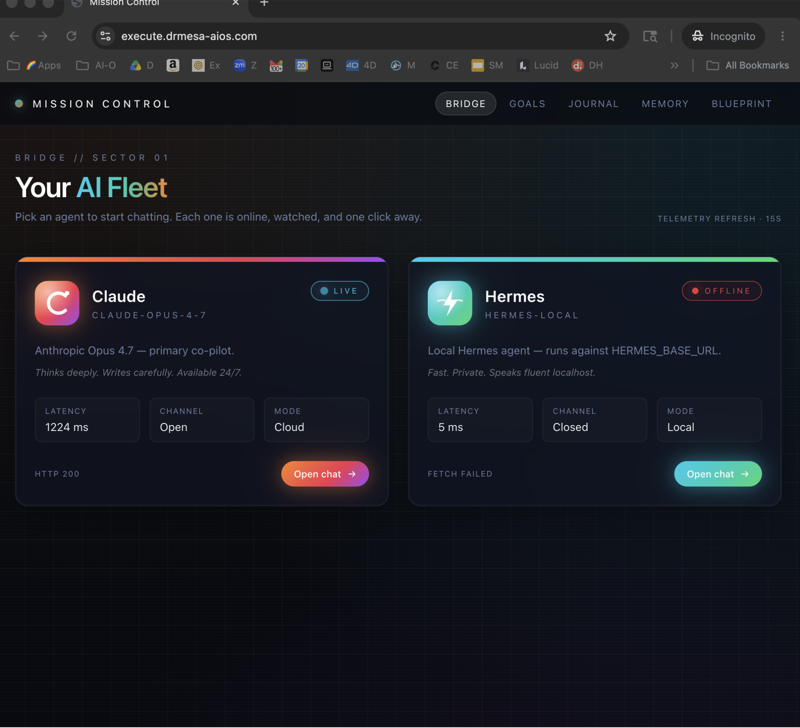
Running a model in a terminal is fine for a quick test, but the real value appears when a model does actual work for you. That is where an agent comes in. Hermes is the AI agent inside Julian's Agent OS, and it is built to take a model and put it to work on genuine tasks — research, drafting, admin and the repetitive jobs that quietly eat your day.
You point Hermes at a model — a local open-weight model running through Ollama, say — and then hand it work in plain language. Because the model runs on hardware you control, you can keep sensitive material private and avoid per-message fees. Swapping one model for another is straightforward, so you can trial a few of the families above and keep whichever suits your workflow best. That pairing — a free model plus an agent that can act on your instructions — is what turns an interesting demo into a daily tool.
If you want to make money running free Chinese AI models, check out the AI Profit Boardroom — the Agent OS and systems are inside. → See how the Agent OS works
Chinese AI models FAQ
Are Chinese AI models free to use?
Many are. A large share of the families above publish open-weight models, which you can download and run at no cost. Some labs also offer paid hosted versions for convenience, but the open releases can be run yourself for free.
What does open-weight actually mean?
Open-weight means the trained model files are published so anyone can download and run them. It is not quite identical to fully open-source software, but for most users the practical benefit is the same: you can use the model on your own hardware, on your own terms.
Can I run these models on a normal laptop?
Smaller versions, yes. Many families come in several sizes, and the lighter ones run well on a typical modern laptop. The largest versions need more powerful hardware, which is why most people start small and scale up only if they need to.
Which Chinese AI model is the best?
There is no single winner. The best choice depends on your task, the languages you work in and your hardware. The sensible move is to try two or three and compare them on your own real work.
Is my data private if I run one locally?
Running a model locally through a tool like Ollama keeps the conversation on your own machine, which is far more private than a hosted service. As always, check the licence and terms for the specific model you choose.
The Bottom Line
Chinese AI models have gone from a curiosity to a core part of the open-weight landscape. Families like Qwen, DeepSeek, Kimi, GLM, Hunyuan, Ernie, MiniMax and LongCat give you a genuine choice of capable models, many of which cost nothing to run on your own machine. The details will keep shifting, but the overall direction is clear: more options, more openness, and more control in your hands. Pick one open-weight model, run it locally with Ollama, then let an agent such as Hermes put it to work. That path is cheap to explore and can quickly become a real part of how you get things done.