For over ten years, my job was winning clicks. Now the click has a rival. When Grok, Google's AI Overviews or a ChatGPT-style search engine answers a question, it reads web pages and cites the ones it trusts — and being cited is a placement almost nobody is competing for yet. That is what a GEO Claude skill is for: teaching Claude to write pages that get cited inside AI answers, not just ranked underneath them.
📺 Watch: This Claude AI SEO Skill Ranks #1 FAST!
🔥 Get the Agent OS as a free bonus: AI Profit Boardroom members get the full Agent OS zip, prompt libraries, daily tutorials and weekly live coaching calls. → Get inside
GEO — generative engine optimisation — is a brand-new set of rankings with hardly anyone on the leaderboard. The overview lives in my Claude AI SEO skill post; this page owns the deeper question: what do you write into the skill file so AI engines cite you? Seven elements. Receipts first.
What GEO actually is
Classic SEO is a fight for position on a results page. GEO is a fight for a sentence inside the answer itself. AI engines behave like fast researchers: they read sources from the web, compose an answer, and cite the pages they leaned on. Every citation is a recommendation delivered the moment somebody asked — and because the discipline is this new, competition is a fraction of a classic ranking's.
And it is teachable, because an engine can only cite what it can find, parse and trust. Those are habits — and habits can be written into a Claude skill that runs on every page. Teach the lesson once and every future article carries it.
The proof, before the teaching
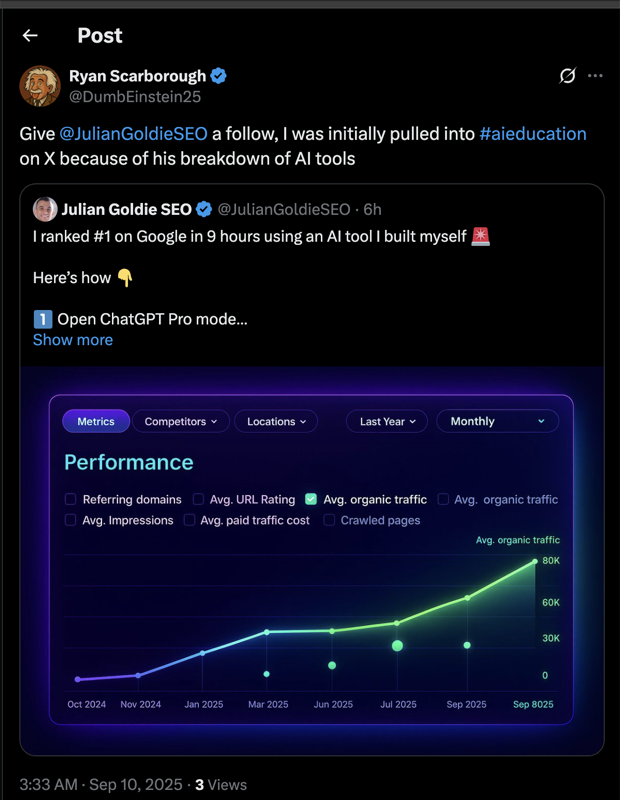
Twenty-four hours after publishing a trending comparison, I asked Grok the question my article answered — and one answer cited my sites three times: juliangoldie.co.uk twice, plus my AIPB site. The full test is in my Grok SEO system post. Separately, the editorial backlinks I built around "best AI community" terms got my site surfacing in Google's AI Overviews for that exact query. And the five-site engine behind these lessons grew from zero to 305, 105 and 34 clicks a day, combining Google and AI traffic.
None of that was luck — just seven instructions applied on every page. Here they are.
📺 Watch: 11 Claude Skills to 10X Your Marketing
The seven elements of a GEO Claude skill
1. Case-study sourcing: every fact from real experience
The first instruction does the most work: every fact must come from real experience — case studies, testimonials, actual usage examples. No invented statistics, no paraphrased documentation, no padding.
Study which sources AI answers cite and the pattern is unmissable: honest, hands-on, specific content wins. A page with genuine information gain — something only you could have written — is the one worth naming; generic fluff never gets cited. So the skill forces Claude to pull from your source of truth before it writes a word.
If you would rather install these GEO instructions than write them yourself, the AI Profit Boardroom has the GEO skills and the Agent OS inside, ready to run. → Get the skills
2. AI-scannable formatting: easy to parse is easy to cite
Second instruction: format for a machine reader in a hurry. Every sentence on a new line. Clean headings. Tables for anything comparative. An FAQ answering the exact questions people ask. Front-load the keyword in the title so the page's job is obvious immediately.
The point is being effortless to lift: an engine assembling an answer grabs from pages it can parse instantly. If your best fact is buried in paragraph nine, the citation goes to whoever put it in a table.
3. Citation-bait structure: comparisons, reviews and guides
Third: default formats. Comparisons, reviews and guides are what AI engines lean on for answers, because most real questions are secretly "which one should I pick?" A head-to-head table and a who-should-choose-what verdict map straight onto how the answer gets written — you are pre-writing the response with your name attached.
My testing habit pays twice here: the hands-on comparisons I run through Goldie Bench exist to pick my own stack, but hands-on comparisons are exactly the content AI engines cite — the testing doubles as GEO.
4. Multi-site, multi-platform presence: the rank-everywhere play
Fourth: never publish a topic in one place. A keyword that matters goes out across five sites, a video and community threads. Different AI engines weight platforms differently, so every extra surface is another chance to be the source an answer picks — the same rank-everywhere drill I run through my Hermes SEO skills on other projects. One article is one lottery ticket; the skill's instruction is never to buy just one.
5. Entity training via links: teach the engines who you are
Fifth: links still matter, but for a newer reason than PageRank. Editorial backlinks and brand mentions beside your key terms teach AI engines to associate you with the topic — exactly the mechanism behind my "best AI community" links putting my site into Google's AI Overviews.
So the skill treats every article as an entity asset: reference-worthy on its own, with anchors and mentions that keep your brand next to the terms you want to own.
6. Freshness and fast indexing: index the hour you publish
Sixth: speed. Engines like Grok sit close to the live web and pick up new pages in hours, so freshness genuinely counts. The instruction: index via API the hour you publish. I push every URL through Indexceptional the moment it goes live, on a schedule my Agent OS runs so it never depends on me remembering.
Trending windows are small. The whole edge is being the first proper answer while people are still asking — and it evaporates if the engines only discover your page next month.
7. The self-improvement clause: lessons that compound
Seventh, and my favourite: the skill reviews its own results. After every batch it looks at which pages earned citations, then proposes updates to its own instructions. A lesson learned once — this table format keeps getting lifted, that intro style never does — applies to every future article automatically. Citation lessons compound.
Packaging the seven elements into a skill
Now the practical bit — easier than it sounds. A Claude skill is just a markdown file with three parts: a name, a when-to-use description, and step-by-step instructions. Write the seven elements above as those instructions and Claude applies all seven on every run. Teach once, cited forever.
If you want the deeper architecture, the 4-A framework shows how I structure the wider skill, and the 13-step pipeline build walks through the full production version end to end. The finished skill file itself ships inside AIPB, so you can install it and edit to fit your business.
📺 Watch: How to Setup Claude Skills in Gemini + Google Notebooks!
The GEO Claude skill checklist
| Element | What you teach Claude | Why AI engines reward it |
|---|---|---|
| Case-study sourcing | Every fact traces to real experience — case studies, testimonials, usage examples | Honest, specific pages with information gain are the ones worth citing |
| AI-scannable formatting | One sentence per line, clean headings, tables, FAQs, front-loaded titles | Easy to parse is easy to lift into an answer |
| Citation-bait structure | Default to comparisons, reviews and guides with verdict tables | They map directly onto how AI answers get written |
| Multi-site, multi-platform | Ship each keyword across five sites, video and community threads | Engines weight platforms differently; more surfaces, more chances |
| Entity training via links | Earn editorial links and mentions beside your key terms | Repeated associations teach engines you own the topic |
| Freshness + fast indexing | Push every URL through the indexing API the hour it goes live | Live-web engines pick up new pages in hours; first proper answer wins |
| Self-improvement clause | Review each batch and propose updates to the skill's own instructions | Citation lessons compound across every future article |
Measuring GEO: a feedback loop measured in a day
Classic SEO makes you wait months to learn whether you were right. GEO tells you in a day. Ask the engines the exact questions your customers ask, and read which sources the answers cite. In the answer? You won. Not there? Study the cited pages and note what they have that yours does not — usually first-hand specifics in a liftable format.
I run these checks weekly on my money queries — the routine sits inside my Grok for SEO workflow — and I keep score of which engines pick up new pages fastest as part of my AI SEO tools training. Live-web engines can cite a page within hours of indexing, so you can publish on Monday and know by Tuesday whether it landed.
GEO Claude skill FAQ
What is a GEO Claude skill?
A markdown skill file that teaches Claude generative engine optimisation: facts from real experience, machine-readable formatting, citation-friendly structures, multi-surface publishing, entity links, fast indexing and self-review. Once written, Claude applies the whole checklist on every article.
How is GEO different from SEO?
SEO wins a position on a results page and earns a click. GEO wins a citation inside the AI-written answer itself. The same honest, specific content often wins both — mine does — but GEO puts far more weight on parseable formatting, answer-shaped structure and speed.
How do I know if AI engines cite me?
Ask them directly. Put your customers' real questions into each engine and read the cited sources. Make it a weekly habit for the queries that drive revenue. The answer either names your site or it does not.
Do I need new content, or can old pages be upgraded?
Old pages upgrade beautifully. Run them back through the skill: add first-hand specifics, break the text into scannable lines, add a comparison table and an FAQ, then re-index. Save brand-new content for trending queries, where being the first proper answer is the whole advantage.
How fast can citations happen?
Faster than anything else I have seen in search. In my own testing, a Grok answer cited my sites three times just 24 hours after publishing — live-web engines pick up pages in hours. My AI Overviews appearance came the slower way, through months of entity-building links. Either route, fast indexing starts the clock.
My verdict
Citations are a land grab, and land grabs reward the early. None of the seven elements is complicated — real experience, scannable formatting, answer-shaped structures, more surfaces, entity links, speed, a loop that learns — but written into a GEO Claude skill, they run on every page you publish without you remembering a single one. The engines are deciding which sites to trust right now, while the leaderboard is nearly empty. Teach Claude the seven elements this week, and give the answer a reason to be you.
If you want your sites to be the ones AI answers name, check out the AI Profit Boardroom — inside you get the GEO skill files, the Agent OS, four weekly coaching calls, daily tutorials and 3,700+ business owners running this alongside you. → Start getting cited