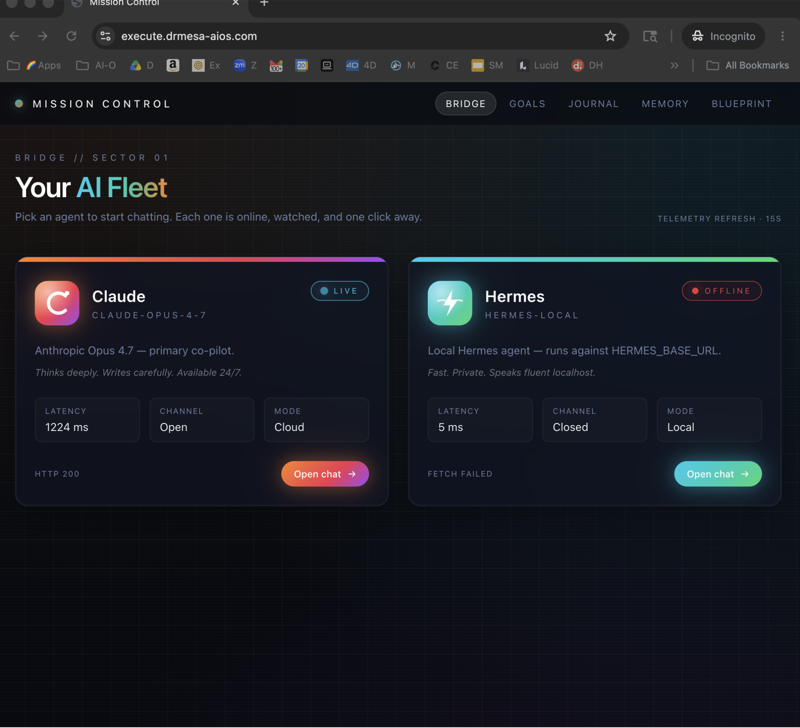
Running Hermes Claude Opus 5.5 works through the official Claude Subscription DirectSDK plugin — the plugin's live model picker mirrors whatever your Claude account offers, so a model newer than its pinned catalog, like Opus 5.5, shows up the moment your account has it, on your existing Claude Code subscription with no API key involved.
📺 Watch: New Hermes + Claude Plugin Update is AWESOME!
🔥 Get the Agent OS as a free bonus: AI Profit Boardroom members get the full Agent OS zip, prompt libraries, daily tutorials and weekly live coaching calls. → Get inside
That one sentence settles the headline question, but it opens three more. Opus 5.5 is nowhere in the plugin's shipped model list, so how does Hermes even see it? What does it cost on Pro versus Max? And is a heavyweight Opus brain worth pointing at a chat agent at all?
You'll get all three answers straight. The mechanics come from the plugin's pinned README (v0.3.0), and the usage claims are mine — what I actually ran on camera in September 2026. If you are starting from zero, the step-by-step walkthrough lives on the Hermes agent with Claude Code subscription guide, and the wider stack sits in the Hermes Claude hub — this page stays on the Opus 5.5 question.
Why Opus 5.5 Is Missing From the Plugin's Pinned List
The Claude Subscription DirectSDK plugin drives the unmodified official Claude Code CLI on a Claude Pro or Max subscription. Its pinned catalog lists five models — Sonnet 5, Haiku 4.5, Opus 5, Opus 4.8, and Fable 5.1. Opus 5.5 postdates that list, which is exactly why people assume Hermes cannot reach it.
The README explains why that assumption fails. The pinned list is only a fallback. When you select the Claude provider inside Hermes, the plugin runs the CLI's initialize handshake, and that handshake returns your account's own model picker with zero upstream requests. Whenever the CLI is logged in, that live picker replaces the static list entirely.
Two consequences follow from that design.
- If your Claude account offers Opus 5.5, the Hermes picker shows Opus 5.5. No plugin update needed, no waiting for a refreshed catalog.
- Unknown model IDs pass through unchanged. The plugin does not invent context metadata for a model it has never heard of, so an explicit newer ID rides through cleanly.
One practical wrinkle from the README before you go looking. Existing installs may need a models refresh to discard a cached list. If you installed the plugin weeks ago and the picker still shows only the original five, refresh the models and the live picker takes over.
For background on the model itself — it is the newer Opus-line model that Claude Code surfaces — our Claude Code Opus 5.5 coverage handles that side, so I will not duplicate it here.
One more thing before the profile flow. I share the exact brain-by-brain profile stack I run — which Claude model gets which job across the whole agent fleet, plus the configs from every video — inside AI Profit Lab. Over 3,000 members are building the same systems in there, and it is $69/mo with the price locked, normally $110.
How to Run Hermes Claude Opus 5.5
The setup shape matches the rest of the cluster, and it comes down to four moves.
- Get Hermes on version 0.21.4 or newer.
- Install the official Claude Code CLI and log in with claude auth login.
- Add the plugin with hermes plugins install claude-subscription-directsdk.
- Create one profile per brain — my pattern is hermes profile create claude opus.
Now the Opus 5.5 nuance. The short names — sonnet, haiku, opus, fable — resolve to the plugin's pinned routes. A newer explicit ID rides the live picker instead. So once the profile exists, run hermes model, and because your logged-in Claude account offers Opus 5.5, it appears as a row in that live picker. Select it there and the profile now answers with the newer model — no API key, no plugin patch, nothing else to configure.
Depth on installs and troubleshooting stays in the setup guide linked above, so I will not repeat it. For me, the profile flow took about 3 minutes end to end in the plugin video I published on 22 September 2026 — still the fastest route I know to a frontier Claude brain answering inside a Hermes agent.
📺 Watch: Claude Opus 5 vs Fable 5
What I Actually Use Opus 5.5 For in Hermes
My routing rule for Claude brains inside Hermes is simple. Opus 5.5 gets the setup-and-build turns — the ones where a single model has to hold an entire system in its head, make decisions, and check its own work. Everything routine goes to a cheaper profile.
The clearest example is the Bot Screen build from my 24 September 2026 video. I handed Opus 5.5 the job of creating and testing the whole Docker setup — not assisting with it, owning it end to end. That is exactly the kind of turn where the heavier Opus brain earns its seat, because a model that gets a build 90 percent right still leaves you debugging the last 10 percent yourself.
For everyday Hermes traffic — status checks, quick summaries, message triage — I do not spend Opus 5.5 turns. That split mirrors how I compare models in Goldie Bench, and if you want to see where per-brain profiles sit inside the bigger operating picture, the Agent OS guide maps the full system.
📺 Watch: Claude + Hermes Agent OS is WILD!
Billing Honesty on Pro and Max
Straight talk on the Claude billing side, because this is where the documentation runs out. The README's plan-rule notes predate Opus 5.5, so its usage-credit treatment on Pro versus Max simply is not documented there. Anyone telling you definitively how Opus 5.5 meters on your plan is guessing.
What you do get is a live signal. The picker labels the rows that draw usage credits, and that label reflects your account rather than a generic assumption. Before you route heavy work at Opus 5.5 in Hermes, open the model picker and read what your own row says — that is the answer that counts.
Nous's standing disclosure sits on top of all of it. Turns bill the subscription's Agent SDK allowance and inherit the logged-in account. In plain terms, your Hermes agent spends the same Claude Code capacity you use at the keyboard, as you. Treat it like a shared tank, not a free one.
When Opus 5.5 Is the Wrong Brain for the Turn
The metering sanity check from the cluster applies directly here. Metering matches the CLI's headless print-mode rate, which the README measures at roughly 60 percent of interactive TUI throughput per five-hour window. Your Hermes Opus 5.5 turns and your hands-on Claude Code sessions drain the same pool, so an agent that pings the big brain forty times a day will show up in your allowance fast.
| Turn type | Brain I route it to | Why |
|---|---|---|
| Full builds, Docker setups, migrations | Opus 5.5 profile | One brain holds the whole system and tests its own output |
| Drafts, summaries, research passes | Sonnet profile | Strong output for a fraction of the draw |
| Status checks, triage, quick replies | Haiku profile | Speed matters more than depth |
My general advice about pricier brains applies unchanged. Pick the heavy model for the turns that genuinely need it and route the rest cheaper. Hermes treats each profile as its own brain, so switching costs you one short command and nothing more.
If you are unsure how to split your own workload across brains — or whether your agent stack should lean subscription or API at all — book a free strategy session and I will map the routing with you.
The Caveat Before You Connect
Three things, said plainly. The plugin is experimental, so expect rough edges. The billing disclosure above is real — every turn inherits your logged-in account. And the community still has an open question about how subscription-driven agents sit with Anthropic's terms. My advice has not changed since the first video, which is to check Anthropic's current Terms before connecting anything. The full picture, including how the handshake authenticates, lives on the Hermes Claude auth page.
Hermes Claude Opus 5.5 FAQ
Is Opus 5.5 in the Hermes plugin?
Not in the pinned catalog — the shipped list stops at Sonnet 5, Haiku 4.5, Opus 5, Opus 4.8, and Fable 5.1. But that list is only the fallback. Once the Claude Code CLI is logged in, the plugin's initialize handshake returns your account's live model picker, and if your account offers Opus 5.5, Hermes shows it. Existing installs may need a models refresh to clear a cached list first.
Does Opus 5.5 need an API key in Hermes?
No. The plugin drives the unmodified official Claude Code CLI on a Claude Pro or Max subscription. You log the CLI in once with claude auth login and Hermes rides that session. There is no API key anywhere in the flow, which is the whole appeal of the DirectSDK route.
Will it cost usage credits?
Check your picker's label — that is the honest answer. The README's plan rules predate Opus 5.5, so Pro-versus-Max treatment is undocumented, and the live picker marks the rows that draw usage credits based on your actual account. Whatever the label says, the standing disclosure still applies — turns bill your subscription's Agent SDK allowance either way.
Run One Real Build on It
Get Hermes to 0.21.4, log the CLI in, install the plugin, create the Opus profile, and pull Opus 5.5 from the live picker. Then hand it a job you have been putting off — a full build, the way I handed it the Bot Screen Docker setup — and judge it on the result.
When you want the complete playbook — every config, every profile split, and 3,000+ members running the same agents — join us inside AI Profit Lab. And if you would rather have the routing plan built around your business first, grab a free strategy session and we will build it together.