Getting an OmniRoute install done is one of the highest-leverage five minutes I have spent this year. You run a couple of terminal commands, a small local gateway starts up on your machine, and from that moment every AI tool you own can pull free models through one endpoint. No juggling a dozen provider dashboards, no paying for tokens while you are still experimenting.
📺 Watch: OmniRoute: New FREE Unlimited AI Coder!
🔥 Get the Agent OS as a free bonus: AI Profit Boardroom members get the full Agent OS zip, prompt libraries, daily tutorials and weekly live coaching calls. → Get inside
In this guide I will walk you through the whole thing exactly the way I did it in my own tutorials: what you are actually installing, where the two commands live, wiring it into Hermes and OpenCode, and how to check it genuinely works before you trust it with real jobs.
What you are actually installing (and why)
OmniRoute is a free, open-source gateway — a router you install locally. It is a small program that runs on your computer, and the easiest way to picture it is as a post office that knows how to reach every AI provider. Instead of pointing your tools at OpenAI or Anthropic directly, you point them at OmniRoute, and it handles the delivery for you.
Why bother? Because once it is running you get routing across 231+ providers — it was 231 when I first covered it and 237 by the next video, and by the time I filmed my OpenCode tutorial the count had grown to 290 providers and over 500 models. Of those providers, 90 have a free tier and 11 are free forever, including OpenCode Zen and Pollinations. When one provider rate-limits you, OmniRoute falls back to another in milliseconds. One endpoint, production grade.
Before you start your OmniRoute install
You need almost nothing:
- A computer with a terminal.
- About five minutes.
- Zero coding ability. As I said in the video: "you just run this command and then you run this." That is genuinely the whole skill requirement.
One worry I hear constantly: "will this bloat my machine?" No. OmniRoute is lightweight because the actual AI work happens on cloud APIs — the gateway just directs traffic. And because it runs locally, it never goes down on you and never rate-limits you itself.
The OmniRoute install, step by step
- Open the OmniRoute GitHub page. The two install commands live in the readme there. I am deliberately not pasting them into this article, because the project updates fast and the exact commands change as it grows — the readme is always current, so copy them straight from the source.
- Run the two commands in your terminal. First one, then the other. That is the entire "technical" part of installing OmniRoute.
- The gateway is now running. You have a small local router sitting quietly on your machine, waiting for your tools to talk to it.
- Set up your API key. This is the step that confuses people, so let me be clear: the key authenticates your own local router. It does not go to a paid provider, and it does not put a card on file anywhere. There is a terminal command that sets up a key for Hermes specifically — I break that down in my free API for Hermes agent guide.
If you want all of this working without touching a terminal yourself, the AI Profit Boardroom has the Agent OS with OmniRoute already wired in. → Skip the setup and start building
Wiring it into Hermes
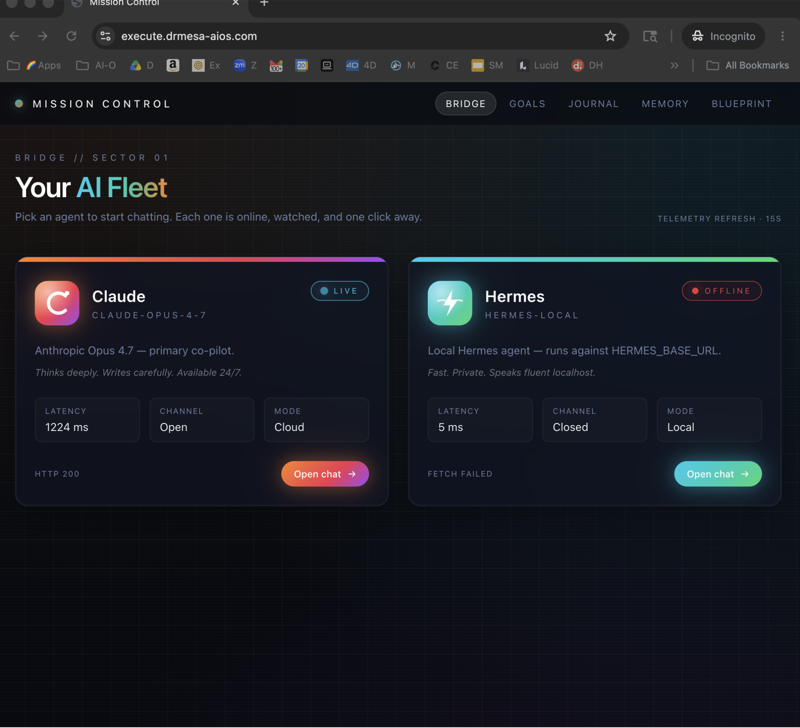
My main use for OmniRoute is running the Hermes agent on free models. Once the gateway is installed, open the Agent OS dashboard, go to Manage → Profiles, and use the OmniRoute profile — that routes the agent through your local gateway instead of a direct provider connection. The full walkthrough is in my OmniRoute Hermes agent tutorial.
One tip from my own setup: I keep a separate agent profile for every API and model I use. It sounds like overkill, but it means I can run the same task through two models side by side and see which one actually performs — that profile-per-model setup is exactly how my Goldie Bench testing runs. If you are brand new to the agent itself, start with how to use the Hermes agent for free and come back here for the routing.
Wiring it into OpenCode
OpenCode is even simpler: open the model dropdown and pick Omniroute. From there you can hop between models like North Mini Code, DeepSeek V4 Flash, Big Pickle and Nemotron-3 Ultra without changing a single setting anywhere else. That dropdown was showing 290 providers and 500+ models when I filmed the tutorial. I have a full OpenCode OmniRoute setup guide, and if you are wondering whether you need both tools, my OpenCode vs OmniRoute comparison explains where each one fits.
Worth knowing: OpenCode Zen is one of the eleven free-forever providers, and pairing it with the agent is a lovely zero-cost stack — I cover that combination in Hermes plus OpenCode Zen.
📺 Watch: Omniroute + OpenCode: 100% FREE AI Coding Setup!
It also plugs into Claude Code and Codex
The same trick works for Claude Code and Codex: point them at your local gateway and they draw from the same pool of providers as everything else. I have done full tutorials on both, so I will not repeat them here — the principle is identical. Any tool that expects an AI endpoint can point at OmniRoute instead, which is the entire beauty of the post-office model.
Verify your OmniRoute install actually works
Here is my highly scientific verification process. First, I literally ask the agent: "are you working?" If it answers, the routing is live. Then — and this is the important bit — I give it a real job. In my test I had it code a landing page from scratch, then opened the result in my browser with one terminal command. A reply proves the connection; a finished page proves the pipeline. Always do both, because a gateway that responds to hello but falls over on a real build is not installed properly, it is decorative.
📺 Watch: NEW OpenClaw Update! (MUST INSTALL)
What you have got once it is running
| Feature | What it means for you |
|---|---|
| 231+ providers behind one endpoint | Every tool points at one local address — up to 290 providers and 500+ models depending on when you count |
| Auto-fallback in milliseconds | A rate-limited provider gets swapped out before you even notice |
| 90 free tiers, 11 free forever | Genuine zero-cost routes like OpenCode Zen and Pollinations |
| RTK compression on input | Strips repeated patterns and duplicated fluff before your prompt is sent |
| Caveman mode on output | Replies come back blunt and brief instead of padded |
| Runs locally | The gateway itself never goes down and never rate-limits you |
The compression pair matters more than it looks. RTK shrinks what goes in; Caveman shrinks what comes out. Fewer tokens per request means you hit free-tier rate limits far less often — and combined with millisecond fallback, that is why the whole thing feels smooth rather than free-but-flaky.
Optional add-on: OpenRouter
Once the base setup is happy, you can bolt on OpenRouter for another 353 models behind one key — and it has a free tier of its own. I only recommend adding it after you have verified the basic routing, purely so that if something misbehaves you know which layer to blame. My OpenRouter fusion API guide covers the pairing properly.
OmniRoute install FAQ
Is it really free?
The router itself is free and open source, full stop. The models are a mix: 90 providers offer a free tier and 11 are free forever. You can run real agent workloads without spending anything — that is exactly how I use it with Hermes day to day.
Why is there an API key if it is free?
Because the key authenticates your own local router, not a paid provider. Think of it as the key to your own front door rather than a hotel bill. Nothing about setting it up involves a payment method.
Will it slow my machine down?
No. The heavy lifting happens on cloud APIs; the local gateway just routes the traffic. It is a post office, not a factory.
What happens when a model gets rate-limited?
OmniRoute falls back to another provider in milliseconds, automatically. Most of the time you will not even notice it happened. And because the gateway runs on your own machine, the router itself can never rate-limit you.
Do I need to be technical?
If you can copy two commands from a GitHub readme and paste them into a terminal, you are qualified. That is the entire OmniRoute install, and it is why I call it non-technical with a straight face.
My honest verdict
Let me set expectations properly, because I said this on camera and I will repeat it here: I wouldn't say this is Fable 5 level, but it can build stuff. The landing page it produced for me was smooth, it worked nicely, and it cost nothing. For drafts, prototypes, bulk tasks and letting agents grind away in the background, free routed models are more than good enough — save the premium models for the work that genuinely deserves them.
Five minutes, two commands from a readme, one endpoint. Of all the AI plumbing I have set up this year, installing OmniRoute has the best effort-to-payoff ratio by a mile.
If you want AI agents running on free models without doing any of this plumbing yourself, check out the AI Profit Boardroom — inside you get the full Agent OS with OmniRoute set up for you, daily tutorials, live coaching calls every week, and me answering your questions personally. → Join the Boardroom and let the agents do the work