Agentic os claude code is the developer guide I wish someone had handed me six months ago when I started wiring Claude Code into my AI operator stack.
If you've been hearing about "Agentic OS" everywhere but you don't know where Claude Code actually fits inside it, this is the guide.
I'm going to walk you through the four layers, the prompts, the install path, and the workflow loop a real developer needs to ship with it.
This is the no-fluff developer reference — bookmark it because you'll want the prompt sequences when you start your first build.
Want the developer prompts and Claude Code templates I use daily? Inside the AI Profit Boardroom I share the exact Claude Code prompts, the Agentic OS templates, and weekly live build sessions with 3,000+ members. Join the Boardroom
What An Agentic OS Means For A Developer
An Agentic OS is a personal operating system for AI agents — a unified dashboard, memory layer, and routing engine that turns scattered AI tools into one developer workflow.
For a developer, that means you stop context-switching between five tools.
You stop copying outputs between agents manually.
You stop losing track of what you decided three sessions ago.
Instead, you brief once, route through the OS, and ship.
Claude Code is the agent at the centre of that loop — the one that actually writes the code.
If you're brand new to the concept, my agentic os breakdown covers the strategic picture first.
This guide assumes you already get the strategic case and you want the developer mechanics.
The 4-Layer Goldie Mission Stack For Developers
I call my Agentic OS architecture the Goldie Mission Stack.
It has four named layers and each one handles a specific job in the developer workflow.
Layer one is intelligence — Claude Desktop plus Claude Code.
Claude Desktop handles the planning, the clarifying questions, and the spec generation.
Claude Code handles the actual code generation, the shell execution, and the deployment.
Layer two is execution — OpenClaw for browser automation.
OpenClaw lets your agents click, type, scroll, and scrape real websites — useful for tasks like form submission, data extraction, or live testing.
Layer three is research — Hermes Agent for multi-step research workflows.
Hermes pulls in documentation, summarises competitor research, and feeds findings back into the build loop.
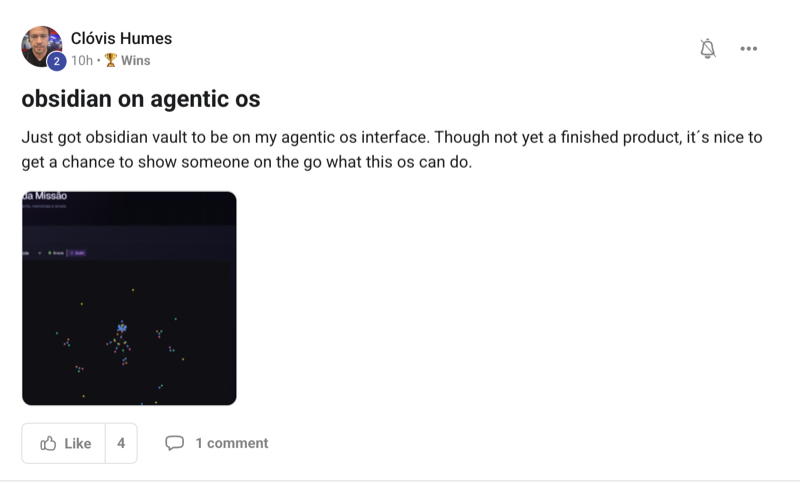
Layer four is self — Obsidian plus OMI for memory.
Obsidian holds the long-term session memory.
OMI holds personal context — preferences, project history, ongoing decisions.
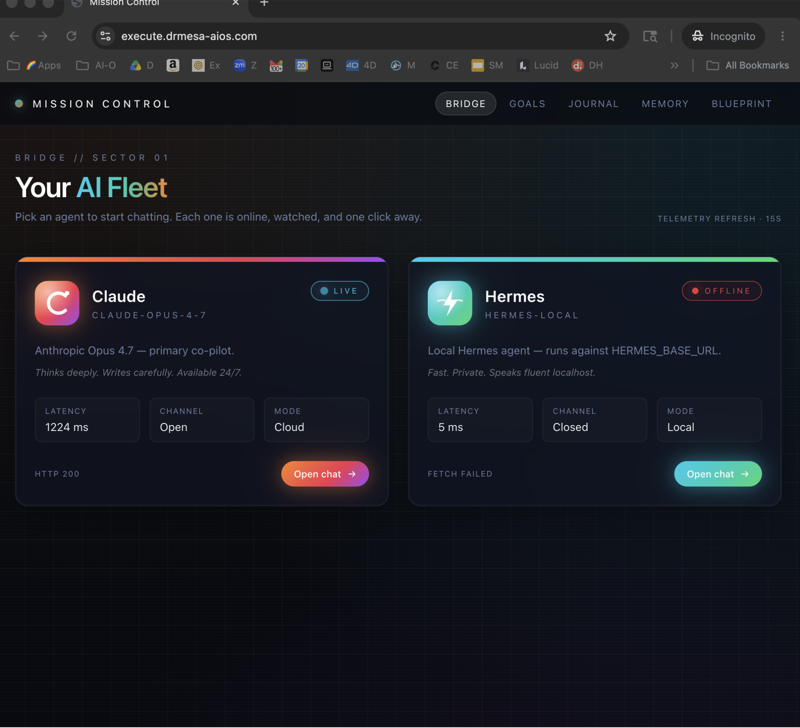
The dashboard sits on top of all four layers and routes briefs between them.
For developers, that means you have a UI on top of your terminal-based agents — clicking, not typing, for the orchestration.
Why Claude Code Specifically — Not Cursor, Not Aider
I tested every major coding agent before settling on Claude Code for the build-layer slot.
Cursor is IDE-first and brilliant for editing one file at a time but it struggles with full project bootstrap.
Aider is solid for git-integrated diffs but it's slower for multi-file refactors.
Cline is great for VS Code users but it inherits the IDE context-switching cost.
OpenCode is fast but missing the rich ecosystem.
Claude Code wins on four specific axes for Agentic OS work.
It's CLI-first so it lives where the terminal lives — perfect for headless orchestration from a dashboard.
It treats the whole project directory as context — great for multi-file work.
It runs shell commands directly — no manual copy-paste between agent and terminal.
It writes, runs, and fixes tests in one continuous loop — proper closed-loop automation.
Those four properties are exactly what the build layer needs and that's why Claude Code is the right choice.
The agent-os-claude post has the full agent-vs-agent comparison if you want the side-by-side.
The Free $0 Developer Stack
You can run the entire Agentic OS Claude Code stack for £0 if you're patient with rate limits.
Here's the exact tool list.
Claude Desktop free tier covers the brief and spec stage — about five briefs a day before rate limits hit.
Claude Code via the Anthropic API runs on a £5 top-up balance that lasts a week of moderate use.
Hermes Agent is fully open source — clone, install, run locally.
OpenClaw is fully open source — same install path.
Obsidian is free for personal use forever.
OMI is free for the basic memory layer.
OpenRouter's Step 3.5 Flash gives you a free fallback API for non-Anthropic tasks.
That's the complete £0 developer stack.
If you want the polished version with Claude Pro and the Anthropic API at higher rate limits, it costs about £20 a month total.
Still cheaper than one Cursor seat.
For the install order and the exact install commands, the agentic os download post is the cheat sheet.
The Build Loop — Step By Step For Developers
Here's the literal developer workflow I run on every new build.
Step one — open Claude Desktop and write a one-paragraph brief.
Step two — answer the three or four clarifying questions Claude asks (framework, auth, database, deploy target).
Step three — Claude generates a detailed spec.
Step four — open a fresh terminal in a new project directory.
Step five — launch Claude Code with claude and paste the spec.
Step six — Claude Code creates the file tree, writes the routes, writes the components, writes the schema, and writes the tests.
Step seven — Claude Code runs the tests automatically and fixes anything that fails.
Step eight — open the local dev server and review the UI in the browser.
Step nine — feed any issues back to Claude Code as follow-up prompts.
Step ten — tell Claude Code to deploy via its deploy command — Netlify, Vercel, or Cloudflare CLI.
End to end, about ninety minutes for a working first version.
That's the developer loop.
It's not magic, it's just the right pieces in the right order.
The Claude Desktop Brief Template I Use
Here's the actual brief template I paste into Claude Desktop on every new project.
"Build me a [TYPE OF SYSTEM] with the following requirements: [LIST OF FEATURES]. Use Next.js 14 with App Router, TypeScript, Tailwind, and shadcn/ui. Use Supabase for auth and database. Write Playwright tests for the critical flows. Deploy target is Netlify. Ask me clarifying questions before generating the spec."
That last line is the key.
Asking for clarifying questions first means Claude Desktop probes for the gaps you forgot to specify.
You get a far better spec from the question-loop than from a one-shot prompt.
The agentic os claude post has more brief templates for different project types.
Wiring Claude Code Into The Dashboard
The dashboard is what makes the Agentic OS feel like one tool instead of five.
Here's how Claude Code wires into it.
The dashboard is a Next.js app you build with Claude Code itself in the first session.
It has four panels — one for each layer of the Mission Stack.
Each panel has a prompt input and a result feed.
When you submit a brief in the intelligence panel, the dashboard sends it to Claude Code via the Anthropic API.
Claude Code runs in your project directory and returns the result.
The dashboard reads the result and shows you the diff.
You approve or iterate from the UI.
You can also click into the research panel to send a Hermes job, or the execution panel to fire an OpenClaw browser task.
The dashboard handles the routing so you never have to manually copy between agents.
For the visual walkthrough of the dashboard, the agentic os command center post has annotated screenshots.
No Flicker Mode — The Setting Every Developer Should Enable
Anthropic shipped a recent Claude Code update called no flicker mode and it's non-negotiable for Agentic OS work.
The flicker problem used to be that long Claude Code sessions would strobe the terminal, eat memory, and eventually crash.
A six-hour Agentic OS build session would slow my MacBook to a crawl.
No flicker mode switches Claude Code into an alternate screen buffer and keeps memory flat regardless of session length.
It also adds mouse support — you can click directly on tool outputs to expand them.
The setup is one environment variable.
export CLAUDE_CODE_NO_FLICKER=1
Add that to your ~/.zshrc or ~/.bashrc and every new Claude Code session launches in no flicker mode.
For the full breakdown of what's happening under the hood, my claude code no flicker mode post is the deep dive.
Enable it before your next build.
The Cross-Agent Handoff Pattern
The most powerful thing about Agentic OS Claude Code is the cross-agent handoff.
Here's a real example from my own workflow last week.
I told the dashboard "build me a competitor monitoring tool that tracks the top ten SEO agencies' pricing pages weekly."
Hermes ran first — it researched the top ten SEO agencies and pulled their company names.
OpenClaw ran second — it opened each agency's pricing page and grabbed the live prices.
Claude Code ran third — it received the research summary and the pricing data, then built a Next.js dashboard that displays the data with a weekly delta column.
The whole orchestration ran from one brief.
I never copy-pasted anything between agents.
The dashboard handled the routing automatically.
That's the cross-agent handoff pattern and it's what makes the Agentic OS feel like one tool.
Common Developer Mistakes On Day One
The most common mistake new developers make is treating Claude Code like a chat replacement.
It isn't.
Chat tools are great for one-off questions but terrible for multi-step builds.
Always brief properly in Claude Desktop first and let Claude Code execute the spec.
The second common mistake is skipping the memory layer setup.
Without Obsidian wired in, every session starts from zero.
That kills the compounding effect that makes this workflow magical over time.
Spend twenty minutes on day one to set up the vault.
The third common mistake is trying to host everything on one weak laptop.
If you're on base-spec hardware, run Hermes locally and Claude Code via API.
The deepseek harness post has the lighter alternative for low-spec machines.
The fourth common mistake is fighting Claude Code on framework choice.
It will sometimes pick patterns you wouldn't have picked yourself.
Listen first.
It's seen patterns across millions of codebases.
Push back when the choice is genuinely wrong — not when it's just unfamiliar.
Performance — Real Numbers From My Build Week
Let me make the leverage concrete with real numbers.
Last week I shipped five real production features using the Agentic OS Claude Code workflow.
Feature one — competitor monitoring tool — ninety minutes.
Feature two — YouTube thumbnail A/B tester with image upload — sixty minutes.
Feature three — Stripe-integrated paywall — seventy-five minutes.
Feature four — Twitter sentiment monitor — forty-five minutes.
Feature five — Zoom meeting summariser — one hundred and twenty minutes.
Total time invested — about six hours.
Total time the same work would have taken six months ago — about thirty hours.
Five times the throughput from one developer.
That's the leverage Agentic OS Claude Code delivers when you wire it correctly.
How The Workflow Compounds Over Time
The workflow gets faster the longer you use it.
Obsidian remembers every previous session.
The first dashboard I built took ninety minutes.
The fifth took thirty minutes because Claude Code reused patterns from the first four.
By the tenth dashboard, the build time was fifteen minutes including tests.
That compounding effect is the real prize.
You're not just shipping faster today.
You're investing in a build engine that gets faster every single week.
If you want the strategic case for why this matters at a business level, my agentic os meaning post explains it in plain English.
Trust Signals For The Workflow
The AI Profit Boardroom has 3,000+ members running variations of this exact developer workflow.
We run five live calls every week including a dedicated AI build call where we walk through real Agentic OS Claude Code projects.
The price is locked at $59 a month forever and backed by a twin guarantee.
If you don't ship something real in 30 days, I refund you and you keep all the training.
That's how confident I am the workflow ships results.
Want a free way to test the workflow first? Join my AI Money Lab — a free community where I share lighter versions of these workflows and 1,000+ free AI agents.
When To Bring In An Agency
The Agentic OS Claude Code workflow scales an individual developer dramatically.
If you need ten of these systems running in parallel across multiple clients, you've outgrown DIY.
That's when you bring in a team.
The Goldie Agency runs this exact stack for SEO and AI clients.
Need this built for you at agency scale? Book a free strategy session with my 7-figure SEO agency Goldie Agency. Book free session
FAQ — Agentic OS Claude Code Developer Guide
What's the minimum hardware for Agentic OS Claude Code?
A base-spec M1 MacBook Air or any Windows laptop with 16GB RAM handles the full stack. If you're on 8GB, run Hermes locally and Claude Code via API to keep memory pressure manageable.
Do I need to install Claude Code globally?
Yes — install it via the official Anthropic installer or npm install -g @anthropic/claude-code. Once installed, the claude command launches it from any directory.
Can I use Agentic OS Claude Code with frameworks other than Next.js?
Absolutely — Claude Code is framework-agnostic. I default to Next.js because it's what I ship with, but the workflow works identically for Astro, SvelteKit, Remix, or any other framework.
How do I share an Agentic OS dashboard with my team?
Deploy it to a private Netlify or Vercel instance with auth. The Mission Stack agents (Hermes, OpenClaw, Claude Code) can run on a shared server with shared Obsidian vaults for team memory.
What happens if Claude Code makes a destructive change?
Always work in a git-initialised project so you can git reset any change Claude Code makes. The build loop includes test runs but you should always review diffs before deploying.
Is Agentic OS Claude Code safe for client work?
Yes — provided you brief properly, review diffs, and run tests before deploying. I use this exact workflow on Goldie Agency client work weekly.
About Julian
I'm Julian Goldie — AI entrepreneur, SEO expert, and founder of the AI Profit Boardroom (3,000+ members). I help business owners scale with AI agents, automation, and SEO.
- 400K+ YouTube subscribers
- 7-figure AI agency (Goldie Agency)
- Daily training inside the Boardroom
- Author of multiple AI automation playbooks
Get my best AI training inside the AI Profit Boardroom
Latest Updates
- Agentic OS — the operator stack overview.
- Agentic OS Claude — the Claude Desktop kickoff prompts.
- Agentic OS Command Center — the dashboard walkthrough.
Further Reading On Agent OS Guide
For deeper walkthroughs on the topics in this article, the Agent OS Guide library has these worth bookmarking.
- Agent OS Guide — the full library of agent OS walkthroughs in one place.
- How Claude Mythos Changed AI — why Claude reshaped the way agent stacks get built.
- Free Claude Code Setup Guide — the elegant way to run Claude Code without paying a cent.
- Hermes Agent OS Q&A — the most common questions about pairing Hermes with Claude answered.
Also On Our Network
- Read on bestaiagentcommunity.com
- Read on aiprofitboardroom.com
- Read on juliangoldieaiautomation.com
- Read on aimoneylabjuliangoldie.com
Related Reading
- Agentic OS Meaning — business-level case for the OS layer.
- Agentic OS Download — install + first build setup.
- Agent OS Claude — orchestration and routing diagram.
- Claude Code No Flicker Mode — the env var fix for long builds.
- DeepSeek Harness — the lighter alternative for low-spec hardware.
Video notes + links to the tools
Get a FREE AI Course + Community + 1,000 AI Agents
If you're a developer in 2026 and you want a single workflow that compounds over time, agentic os claude code is the one to learn this quarter.