Is DeepSeek Harness better than Claude Code?
We tested it properly instead of guessing, and the deepseek harness vs claude code result splits cleanly down the middle.
DeepSeek Harness won on speed, on cost, and on how much of the stack you actually own.
Claude Code won on the thing you get judged on, which is what the finished build looks like.
Below is the whole test, the numbers, and the rating both of us gave at the end.
Short answer
No, not yet — but it is closer than the price suggests, and it is only on version 0.1.
Kasra Dash scored Claude Code a 9 out of 10.
I scored DeepSeek Harness a 7 out of 10, and Kasra thought that was generous.
Neither of us is moving our daily work off Claude this month.
Both of us have already moved specific tasks across.
How the test was set up
One prompt. Both agents. No extra context, no follow-ups, no second attempts.
We asked for a 3D animated accountancy website and a simple game to go with it.
DeepSeek Harness ran DeepSeek V4 Pro, the model that was built for it.
Claude Code ran Claude Opus 5 on high.
That is deliberately like for like — the point was to compare the harnesses and the frontier models fairly, not to stack the deck.
Round one: speed
DeepSeek Harness finished the entire build in 11 minutes.
Not a first draft. Finished.
Claude Code passed 30 minutes and was still working when we moved on to another part of the video.
If you build for a living, that gap is not a stat.
It is the difference between three attempts in an afternoon and one.
Round one goes to DeepSeek, and it is not close.
Round two: what came out
Then we opened both sites.
The Claude build had animation that tracked the mouse, so the page responded as you moved across it.
More impressively, it referenced things we never typed — including Northwest England — because it carried context from earlier work.
That is the behaviour you want from something that is meant to work like a team member rather than a vending machine.
The DeepSeek build looked animated and cartoony.
Its Tetris ran fine.
But a cartoon game on an accountancy website is a mismatch that any client would notice immediately, and Kasra flagged it straight away.
The Claude game also felt smoother to play.
Round two goes to Claude.
Worth saying plainly: neither build was ready to publish.
Both needed more context and more prompting.
Claude just landed closer to the finish line.
Round three: cost and token burn
This is where it gets interesting.
DeepSeek Harness burned 483,000 tokens on that one-page website.
Claude was at 48,000 tokens at the 20-minute mark on the same job.
Ten times the tokens for the less polished result.
I said on camera that it felt like being cheated, and that reaction is fair.
But DeepSeek is about 56 to 57 times cheaper per token.
The whole build cost roughly 5 cents from a $10 top-up.
So even burning ten times the tokens, DeepSeek is far cheaper in real money.
Round three goes to DeepSeek, with an asterisk: that only holds while the price stays where it is.
| Round | Winner | Margin |
|---|---|---|
| Speed to finish | DeepSeek Harness | 11 min vs 30+ min |
| Build quality | Claude Code | Clear on look and context |
| Cost of the run | DeepSeek Harness | ~5 cents vs ~57x more |
| Token efficiency | Claude Code | 48k vs 483k |
| Ownership and flexibility | DeepSeek Harness | Free, open, swappable |
| Maturity | Claude Code | Shipping vs v0.1 preview |
Why 105,000 people starred it in two days
DeepSeek Harness landed on GitHub and picked up 105,000 stars in roughly two days.
That puts it among the fastest growing open source projects ever launched.
The reason is the model-agnostic design.
You run the harness free, and you choose the brain that goes inside it.
If you want the cheapest possible setup, you can plug a free model in — OpenCode works as a free brain — and pay nothing at all.
Compare that with a closed product where the model is decided for you and billed monthly.
Whatever you think of the output, that is a genuinely different proposition.
The v0.1 caveat that changes the score
This is a developer preview.
Version 0.1. Roughly a tenth of what it will be at a real release.
Scoring it as a finished product is not the right lens.
That is a large part of why I gave it a 7 while Kasra was harsher.
I also just like what competition does.
If DeepSeek ships something serious in two or three months, Claude has to answer it, and everyone reading this benefits from that.
How I actually use both
I am not picking a side and defending it.
Client-facing work runs on Claude Code, because polish is the product.
High-volume, repetitive and disposable work runs on DeepSeek Harness, because attempts cost pennies and speed compounds.
The switching is automated, not manual.
Inside my agent operating system an orchestrator decides which engine gets the job.
I did not install the harness by hand either — I asked Claude to set it up, test it, and wire it in, so I never had to learn another interface.
That is the pattern I would recommend to anybody: let the orchestrator hold the tools, so you are never locked into whichever one is winning this week.
🔥 Want the full side-by-side setup?
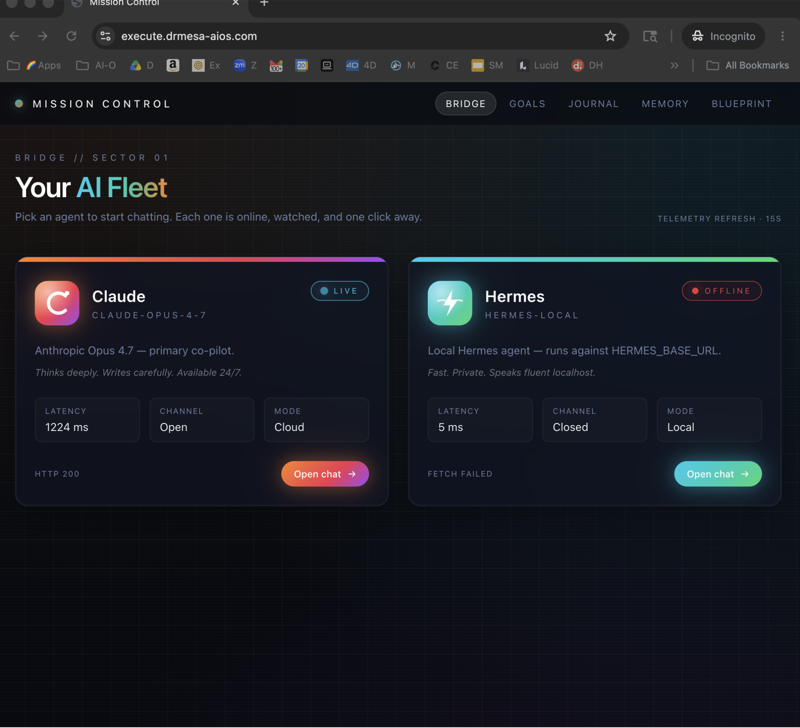
Inside the AI Profit Boardroom I show the whole Agent OS — DeepSeek Harness, Hermes and Claude Code in one dashboard, plus weekly coaching calls with 4,000+ members.
Who should use which
Choose Claude Code if you are shipping for clients, if quality is what you are paid for, and if your existing context already lives there.
Choose DeepSeek Harness if cost is your constraint, if you want to own and modify the stack, or if you are generating at volume.
Choose both if you are serious, because the cost difference is too big to ignore and the quality difference is too visible to hand-wave.
FAQ
Is DeepSeek Harness better than Claude Code? Not on output quality today. It is dramatically faster and cheaper, and Claude Code still produced the better website in a like-for-like test.
What did each one score? Claude Code got a 9 out of 10 from Kasra Dash. DeepSeek Harness got a 7 out of 10 from me, with Kasra scoring it lower.
How fast is DeepSeek Harness? It completed the full build in 11 minutes while Claude Code was still working past the 30-minute mark.
Does DeepSeek Harness waste tokens? Yes. It used 483,000 tokens against Claude's 48,000 at 20 minutes. It is a very verbose model, but it is priced low enough that it still costs far less.
Is it worth trying? At around 5 cents a build and a free open source harness, the cost of finding out is effectively nothing.
What "v0.1 developer preview" really means
Every criticism in this post needs the same footnote.
DeepSeek Harness is version 0.1.
A developer preview — roughly a tenth of what it will be at a real release.
Things will change fast, and things will break.
That is not a warning against trying it; it is a warning against building your business on it this month.
It is also why my score and Kasra's differ.
He rated what is on the screen today.
I rated where it is heading, and at 105,000 GitHub stars in two days it is heading somewhere fast.
If you have used AI tools for more than a year, you already know how quickly a 0.1 becomes the default.
How to try it in an afternoon
You do not need to become a DeepSeek Harness expert to find out whether it fits.
Here is the shortest honest route.
Get your existing agent to install it. I did not set it up by hand. I asked Claude to install it, test it, and wire it in, and that is genuinely how I would recommend starting.
Give it a real job, not a demo. Toy prompts hide verbosity. Send it something you would otherwise do yourself, so the token burn and the quality gap show up honestly.
Watch the counter. Ours hit 483,000 tokens on a single page. That is the number that tells you whether the price advantage survives your actual workload.
Compare against your normal tool on the same brief. Same prompt, same day, no extra context. That is the only comparison worth anything.
Then decide per task, not per tool. This is the bit most people get wrong. The question is never "which agent do I use", it is "which agent should do this specific job".
The lesson underneath the test
There is a bigger point here than which agent won.
Twelve months ago, a free open source coding agent that finished a full build in 11 minutes would have been the headline of the year.
Now it is a normal week, and the honest reaction from two people who do this daily was "it's good, it doesn't blow my socks off".
That is how fast the floor is rising.
Which means the durable skill is not learning any one tool.
It is building a system where tools plug in and out — an orchestrator that holds your context, your workflows and your standards, and treats the agent underneath as a component.
Do that, and the next launch is an upgrade instead of a migration.
Skip it, and you will be relearning an interface every six weeks for the rest of the decade.
About Julian
I'm Julian Goldie — AI entrepreneur, SEO expert, and founder of the AI Profit Boardroom (4,000+ members). I help business owners scale with AI agents, automation, and SEO.
- 400K+ YouTube subscribers
- 7-figure AI agency (Goldie Agency)
- Daily training inside the Boardroom
- Author of multiple AI automation playbooks
→ Get my best AI training inside the AI Profit Boardroom
Related reading
The deepseek harness vs claude code answer today is Claude for the work that gets seen, DeepSeek for everything else.