The fastest way to understand Hermes agent use cases is to build one ridiculous thing — so I built Jarvis, and in this post I'll show you exactly how the pieces fit together.
I'm talking a real voice assistant.
Wake word, spoken responses, the lot.
I say "Jarvis, build me a galaxy I can swirl with my mouse" and it says "Built and running, sir" — and a swirling galaxy appears on my screen.
I say "Jarvis, show me my numbers" and it pulls up my stats.
And here's the part that should get your attention: I don't code, and the core of this is free open-source software.
Watch it working before we break down the recipe.
The Three-Part Recipe Behind My Favourite Hermes Agent Use Case
People assume this took a development team.
It took three components and a lot of conversations.
Part one is Hermes agent, the open-source project, providing all the agentic capabilities at the core of the system.
Part two is ElevenLabs, which generates the voice responses and turns a text agent into something that talks back like an assistant.
Part three is Claude, working in the background on improvements and the system itself — we used it to build the setup out and get ideas for it.
That's the whole architecture.
If you're looking to build it yourself, just combine Hermes with ElevenLabs and get Claude to help you in the background.
🔥 Want my exact Jarvis setup as a download? Inside the AI Profit Boardroom, the Agent OS section has the zip file with the prompts, a full video tutorial, and daily updates. Plus weekly coaching calls where you can share your screen and get help live. 3,000+ members. → Get the setup here
What The Finished System Can Actually Do
Once the parts are connected, the Hermes agent use cases stack up fast.
Here's everything mine does today.
It answers questions about my own work — I asked "what have I been working on this week?" and it correctly said thumbnail work, because it reads my logs.
It builds apps, games and websites on request, all saved into a builds library I can revisit.
It opens websites and controls the browser — "Jarvis, open up juliangoldie.com" and the site loads.
It runs on a wake word, so "Jarvis" or "Hermes" switches it on hands-free.
It sits in the background in wall mode, ready and waiting, and I can type to it whenever speaking isn't convenient.
It shows my full conversation history and everything previously built.
It even tells jokes — bad ones, which is somehow correct for a Jarvis.
The Agent OS video below shows how the build-anything layer works with Hermes and Claude together.
The Builds Library: Proof These Hermes Agent Use Cases Are Real
I want to show you receipts, not promises.
Scroll through my builds section and here's what's sitting there.
A habit tracker, built in one session and still in use.
A complete website, built end to end through conversation.
A Japanese flashcard game for language learning.
A meditation timer.
Videos — yes, it can create those too.
Every single one was built by describing what I wanted, and every one is saved so I can come back to it later.
And let's be honest: this is the worst it's ever going to be.
It's not going to get worse — it only gets better from here.
The Memory Layer: Why My Jarvis Actually Knows Things
A voice assistant without memory is a parlour trick.
Mine is linked to my Obsidian vault — I call it the memory galaxy.
Everything we do together gets logged automatically, so the system builds a permanent record of every conversation and every build.
That's how it answers questions about my week accurately instead of hallucinating.
It also means nothing I build ever gets lost, because the log is the single place where everything lives.
I documented that whole setup in my Hermes second brain post, and this video shows the memory integration live.
Beyond Jarvis: The Team Layer Most People Miss
The voice assistant is the front door, but there's a whole house behind it.
Say "Jarvis, show me my team" and it lists every agent in the system — Claude, OpenClaw, Hermes, all working together.
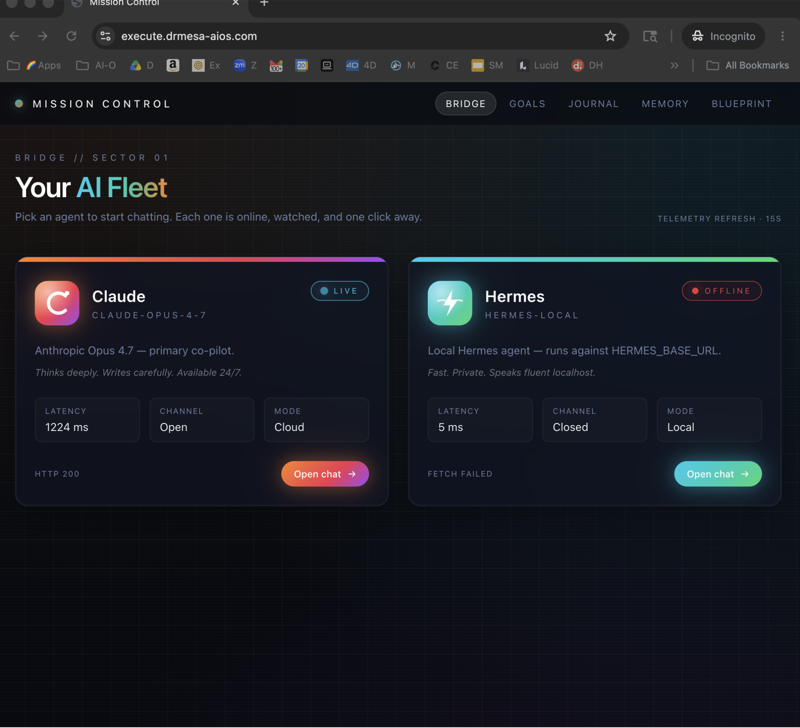
There's mission control for oversight, Paperclip built in with AI agent teams, and an agent group chat where Hermes talks to Claude and Gemini directly.
There's a control room, a goal mode for autonomous work, and a plain chat mode for quick questions.
Hermes also links with MCPs, so external tools plug straight in, and you manage models from the dashboard.
For getting actual work shipped, I'll be honest — the team tools like Paperclip move faster than the voice layer.
The Hermes agent swarm approach is the natural next step once Jarvis is running.
The Zero-Cost Variant: Qwen + Ollama
If ElevenLabs and Claude credits put you off, there's a free path.
I built a similar agent factory using Qwen 2.5 Coder running on Ollama.
It's a free local model, which means no API costs at all, and I can speak or type to it while it builds things live on screen.
Local models keep improving, and the fact that this already works for free is mind-blowing when you think about it.
My Ollama and Hermes guide covers that route.
Cost Breakdown: What This Actually Costs To Run
| Component | What it does | Cost |
|---|---|---|
| Hermes agent | Core agentic capabilities | Free (open source) |
| Qwen 2.5 Coder + Ollama | Free local model option | Free |
| ElevenLabs | Voice responses | Free tier, then credits |
| Claude | Background building + improvements | API or subscription |
| Obsidian | Memory vault | Free |
The honest summary is that you can run a capable version for nothing, and the full Jarvis experience for the cost of voice credits and a Claude plan.
Compare that to what people pay for "AI assistants" that can't open a browser tab.
🔥 Skip three weekends of trial and error. The AI Profit Boardroom has the full Hermes Agent OS install, the prompts, daily new tutorials, and a community that's always online — I answer questions personally. 3,000+ members building real automations. → Join the Boardroom
What I'd Build First If I Were Starting Today
Don't start with the galaxy demo, as fun as it is.
Start with the install, then connect the Obsidian memory before anything else.
Memory is what turns every later use case from impressive to genuinely useful.
Then add voice with ElevenLabs, then the wake word, then computer use.
By the end you'll have your own Jarvis — and a builds library filling up with things you made by talking.
I'd genuinely love to know what you'd build next with a system like this, because that question is what keeps this project improving every single day.
FAQ: Hermes Agent Use Cases
What are the main Hermes agent use cases?
Voice assistance with a wake word, building apps and websites by conversation, computer and browser control, persistent Obsidian memory, multi-agent teams, and MCP integrations with external tools.
How do I build a Jarvis with Hermes agent?
Combine three parts: Hermes agent for the agentic core, ElevenLabs for voice responses, and Claude to help build and improve the system in the background. Add a wake word for hands-free control.
Is building a Hermes Jarvis expensive?
No — Hermes is open source and free, Obsidian is free, and a free local model like Qwen 2.5 Coder on Ollama removes API costs entirely. Voice credits and Claude are the only optional paid parts.
Can Hermes agent build real apps?
Yes — my builds library includes a habit tracker, a complete website, a Japanese flashcard game, a meditation timer and videos, all built through conversation without writing code.
Does the Hermes Jarvis assistant work reliably?
Mostly, with honest rough edges — sometimes it's not smooth. But it improves constantly, and the current version is the worst it will ever be.
What's the difference between Hermes voice mode and the workspace tools?
The voice layer is the most fun and most impressive front end, while workspace tools like Paperclip and agent teams are faster for shipping actual work. The best setups use both.
About Julian
I'm Julian Goldie — AI entrepreneur, SEO expert, and founder of the AI Profit Boardroom (3,000+ members). I help business owners scale with AI agents, automation, and SEO.
- 400K+ YouTube subscribers
- 7-figure AI agency (Goldie Agency)
- Daily training inside the Boardroom
- Author of multiple AI automation playbooks
→ Get my best AI training inside the AI Profit Boardroom
Also On Our Network
- 🌐 Read on bestaiagentcommunity.com
- 🌐 Read on aiprofitboardroom.com
- 🌐 Read on juliangoldieaiautomation.com
- 🌐 Read on aimoneylabjuliangoldie.com
Related Reading
So that's the recipe, the receipts and the costs — and if you take one thing from this post, make it this: the best Hermes agent use cases aren't waiting for some future model release, because everything above runs today, and building your own Jarvis is the most fun way to learn what Hermes agent use cases can really do.
📺 Video notes + links to the tools 👉