You can start an AI business today with zero money and land your first paying client within 30 days.
This blueprint gives you the exact service to offer, the exact message to send, and the exact pricing to charge — week by week, day by day.
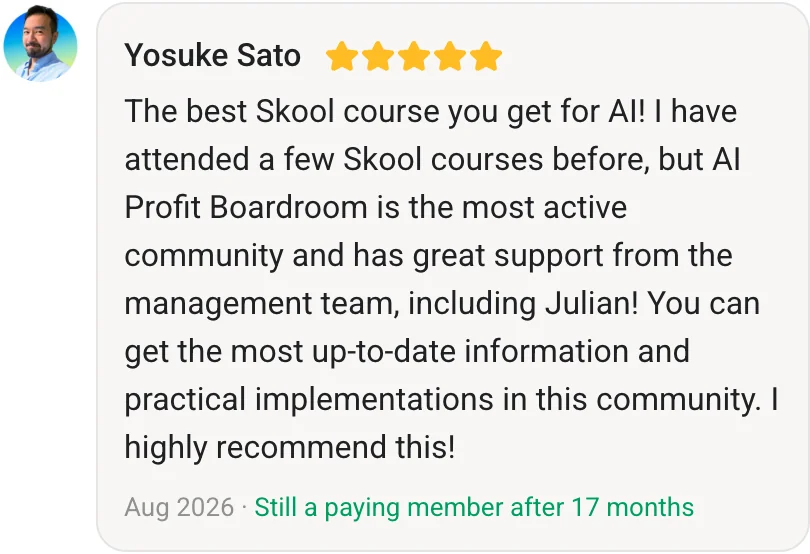
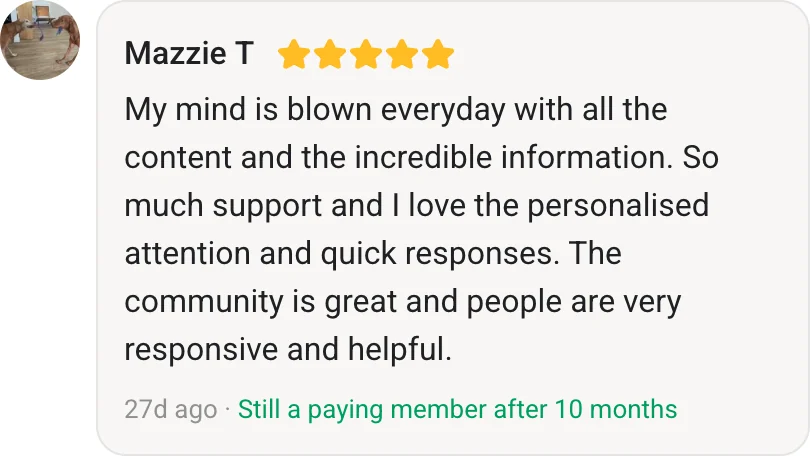
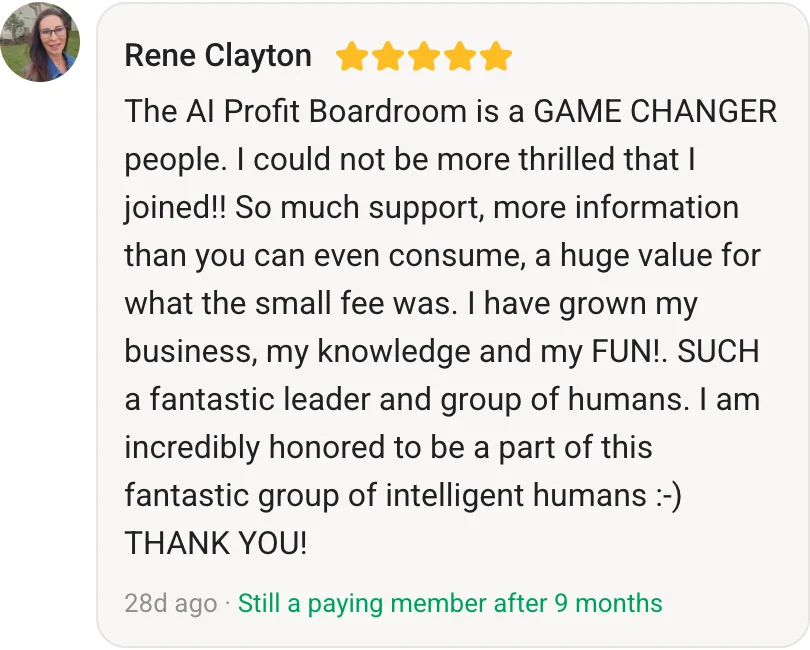
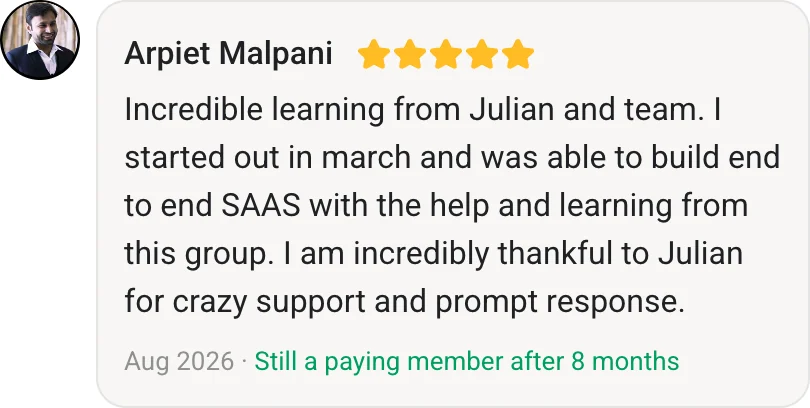
🔥 Want a proven system to start your AI business fast? AI Profit Boardroom has live coaching, done-for-you pitch scripts, and people already earning £1,000–£5,000/mo from their AI business — $69/mo. → Join here
What You'll Have By Day 30
By day 30, you'll have a live AI service business with your first paying client.
Most people who follow this plan earn £500–£1,500 in their first month.
You'll have a service offer, a simple portfolio, a working outreach system, and at least one testimonial.
Everything built with free tools. No investment required.
The Free Tool Stack You Need
- ChatGPT (free tier) — your primary production tool for writing, content, and client deliverables
- Claude (free tier) — polish and quality-check everything before it goes to a client
- Canva (free tier) — build your portfolio PDF and any visual deliverables
- LinkedIn (free) — find and contact your first clients without paying for ads or tools
- Google Docs (free) — deliver all work in professional, shareable documents
- Notion (free tier) — manage your clients, track outreach, and store your templates
Your 30-Day Plan
Week 1 (Days 1–7): Install, Learn, Build Demo
Day 1: Pick ONE service to offer. The three fastest options are: (a) AI content writing — blog posts, LinkedIn posts, email newsletters for businesses, (b) AI social media management — writing and scheduling all social posts for a business, or (c) AI business automation consulting — helping small businesses identify and set up free AI tools. Pick the one that matches your background most closely.
Day 2: Set up your free tool stack. Create accounts on ChatGPT, Claude, Canva, and Notion. Spend one hour learning how to prompt ChatGPT for your chosen service. Don't overcomplicate it — just test it.
Day 3: Build your first demo piece. If you chose content writing, write a 500-word sample blog post for a fictional small business. If you chose social media, create a set of 5 sample posts for a fictional brand. If you chose automation consulting, write a 1-page report recommending 5 free AI tools for a small business.
Day 4: Build a one-page portfolio in Canva. Include your name, your service offer, 2–3 demo samples, and a contact email. Export as a PDF. This is your proof of work.
Day 5: Write your pricing ladder. Here's what to use:
- Starter offer (for closing your first deal): Free first project or £50–£100 — just enough to get started and get a testimonial.
- Entry price (after first testimonial): £300–£500 for a project or first month of a service.
- Standard price (after two testimonials): £750–£1,000/mo for a retainer.
- Premium price (once you have proof and case studies): £1,500–£2,500/mo for a full service package.
Day 6–7: Write your outreach message. Here is the exact DM template to use on LinkedIn:
"Hi [First Name], I noticed you're a [their role] at [their company]. I help [type of business] with [specific problem] using AI tools — usually saving them [X hours] a week or [£X] a month. I've put together a quick demo of what I could do for you. Would it be OK to send it over? No pitch, just proof."
Personalise the brackets for each prospect. Keep the message under 60 words.
✅ Week 1 goal: One polished demo, a one-page portfolio PDF, and your outreach DM written and ready.
Week 2 (Days 8–14): Pitch And Land First Client
Day 8–9: Find 30 target prospects on LinkedIn. Look for: small business owners with 1–20 employees, coaches, consultants, service businesses, local businesses with a weak or non-existent social media presence. Filter by location, industry, or job title.
Day 10: Send your DM to the first 15 prospects. Track every message in Notion — who you messaged, when, and what they said. Do not skip this step. If you don't track it, you won't know what's working.
Day 11–12: Send your DM to the remaining 15 prospects. Follow up with anyone who hasn't replied after 48 hours. The follow-up message should be even shorter:
"Hey [First Name], just following up on my message from [day]. Happy to send you the demo — takes 30 seconds to look at. Worth it?"
Day 13–14: Anyone who shows interest goes straight to a discovery call. On that call, ask three questions: What's your current content or marketing process? How much time does it take? What would be different if it took half the time? Then offer your starter package — a small, low-risk first project for £100 or free if they're hesitant. Your goal is one paid project or one agreement to do a free project for a testimonial.
✅ Week 2 goal: 30 prospects messaged. At least 3 replies. At least 1 discovery call booked.
Week 3 (Days 15–21): Deliver And Get Testimonial
This is the week where the business becomes real.
Do the project you agreed to in week two.
Use ChatGPT for the first draft and Claude to polish it.
Deliver it in a clean Google Doc within the agreed timeframe — ideally 24–48 hours.
Speed impresses.
Most clients expect to wait a week for a freelancer.
If you deliver in a day, they remember it.
After delivery, send this exact message:
"Really enjoyed working on this with you. If you're happy with the result, would you be willing to write a short testimonial — even just two or three sentences? It would mean a lot as I'm building out my client base."
Most people say yes when you ask like this.
Get the testimonial in writing — not as a verbal compliment.
Now you have proof. Everything from this point is easier.
✅ Week 3 goal: First project delivered. First written testimonial secured.
Week 4 (Days 22–30): Raise Price And Scale
Your pricing ladder changes the moment you have a testimonial.
Days 22–23: Update your LinkedIn profile, your Canva portfolio, and your outreach DM to include the testimonial. Rewrite your DM opener to include a one-line version: "I recently helped [type of business] with [problem] — here's what they said: [testimonial quote]."
Days 24–26: Send 30 more cold DMs using your updated message. This time, set your opening offer at £300–£500 for a starter project. Do not offer anything for free this week. You have proof now — charge for it.
Days 27–28: Run discovery calls with anyone who expresses interest. Push for a paid project or a monthly retainer starting at £500. For clients who want to test the water, offer a one-week trial at £150.
Days 29–30: Close at least one paying deal. Invoice immediately. Deliver on time. Reinvest your first payment into one paid tool that makes your workflow faster or your output better.
✅ Day 30 goal: £500–£1,500 in paid or invoiced work. One testimonial. One paying client. One repeatable outreach system.
What Blocks Most People At Day 7
The single biggest blocker is indecision about which service to offer.
Most people spend their entire first week researching instead of building a demo.
The service doesn't have to be perfect. It has to exist.
Pick one. Build a demo. Start pitching. Refine it after you've had real conversations with real prospects.
The second blocker is sending too few messages.
30 cold DMs in a week sounds like a lot. It's not.
With a 5–10% response rate, 30 messages gets you 2–3 conversations. 2–3 conversations gets you 1 paying client.
If you only send 5 DMs and get no reply, you haven't been rejected. You just haven't tried.
The third blocker is underpricing out of fear.
Charging £50 for work that should cost £300 does not make it easier to close clients.
It makes you seem less credible.
Price based on the value you deliver, not on your level of confidence. Confidence comes after you close the first deal.
🔥 The fastest path to your first AI business income. AI Profit Boardroom has real pitch scripts, live coaching, and a community of AI business owners already earning — $69/mo. → Join now
FAQs
Do I need to register a company before I start? No. You can start as a sole trader and invoice clients from day one. In the UK, you only need to register with HMRC once your earnings exceed £1,000 in a tax year. Start earning first, handle the admin second.
What if a prospect asks how long I've been doing this? Be honest and frame it right: "I specialise in AI-assisted content and I've been building this service for a short time — which means I'm hungry, fast, and I offer far more value for the price than established agencies." First clients are won on hustle and price, not tenure.
How do I handle pricing if someone says it's too expensive? Drop to your starter offer — a small, defined project at £100–£150. If they say that's too expensive, they were never a serious prospect. Move on. Do not keep lowering your price to close a bad client.
What should my first client offer actually include? Keep it narrow and specific. "5 LinkedIn posts per week for the month" or "4 blog articles in 30 days" or "a 3-email welcome sequence for your email list." The more specific the offer, the easier it is to deliver and to price.
Can I do this while working a full-time job? Yes. Pitching 30 prospects takes 2–3 hours. Delivering a starter project takes 3–5 hours. You can build this entire business in the evenings and weekends of one month without affecting your day job.
When should I reinvest my first earnings? After your first £300 or more, consider paying for ChatGPT Plus ($20/mo) for faster, better outputs. That's the first upgrade that pays for itself immediately. Everything else stays free until you're earning £1,500+/mo consistently.
🔥 Start your AI business with the support of people already earning. AI Profit Boardroom gives you the exact roadmap, pitch scripts, and live coaching to go from zero to paying clients fast — $69/mo. → Join now