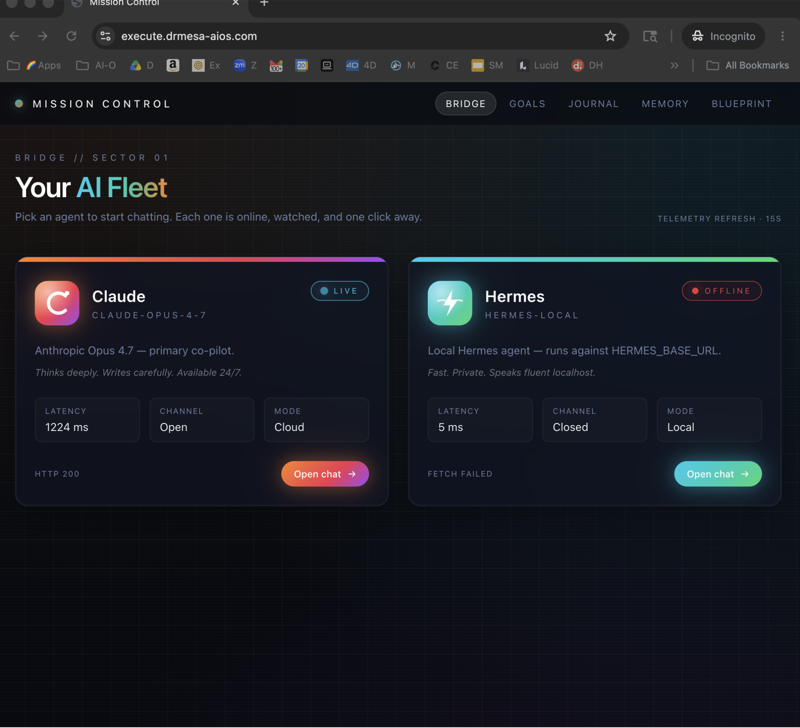
OpenClaw Mission Control vs DIY dashboards is a question I've answered for myself the hard way — here's the comparison so you don't have to make the same mistakes I did. I've tried building my own OpenClaw dashboard, other open-source options on GitHub, the default OpenClaw setup (no real dashboard), and Mission Control by Builder Labs.
This post is the honest comparison.
The Quick Verdict
Mission Control by Builder Labs wins for most users. The reasons are 5-minute install versus hours building your own, more polished than alternatives I've tested, active maintenance, and free open source.
DIY only wins if you have very specific needs Mission Control doesn't cover.
Option 1 — Building Your Own Dashboard
What it looks like to go DIY. You'd plan dashboard features, write code for each panel, connect to OpenClaw API, build authentication, and test and debug.
The pros are full customisation, tailored to your specific needs, and a learning experience. The cons are hours of work (often days), ongoing maintenance burden, and you become a software developer now.
My honest experience: I tried this. It took hours. Output was less polished than Mission Control. I don't recommend.
Option 2 — Other GitHub Open-Source Dashboards
There are several OpenClaw dashboard options on GitHub. Some are good, some are buggy, and most lack features Mission Control has.
The pros are variety of approaches and some that specialise (e.g. analytics-only). The cons are that quality varies wildly, maintenance is hit-or-miss, and they're often missing features you'll need.
My honest experience: I tried 3 different options. Mission Control was the cleanest by a margin.
Option 3 — Default OpenClaw Setup
OpenClaw comes with limited default monitoring. You can see basics in terminal and you can interact via the standard gateway.
The pros are zero install and no external tools. The cons are no real dashboard, no multi-agent visualisation, no task board, and no memory browser.
My honest experience: functional but limited. For multi-agent work, you NEED a dashboard.
🔥 Want my Mission Control vs alternatives playbook? Inside the AI Profit Boardroom, I share my comparison data, decision rules for picking dashboards, and 30-day road map. Plus 6-hour OpenClaw course and weekly live coaching. 3,000+ members. → Get the playbook
Option 4 — Mission Control By Builder Labs
The focus of this post.
The pros are 5-minute install via OpenClaw chat, polished UI, comprehensive features (Sessions, Agent Squad, Task Board, Memory Browser, Token Usage, Scheduled Jobs, Spawn Control), active maintenance, and free open source.
The cons are that some users prefer minimalist tools, the mobile UI is limited, and it's heavier than the default OpenClaw setup.
For 95% of OpenClaw users, this is the best choice.
Side-By-Side Decision Table
| Aspect | DIY | Other GitHub | Default | Mission Control |
|---|---|---|---|---|
| Setup time | Days | Hours | Zero | 5 min |
| Polish | Variable | Variable | Limited | High |
| Maintenance | You | Community | OpenClaw team | Builder Labs |
| Multi-agent support | Build it | Sometimes | Limited | Native |
| Cost | Time | Free | Free | Free |
| Best for | Custom needs | Specific use cases | Trying OpenClaw | Most users |
For most users, Mission Control wins.
Cost Of Each Option (In Time)
Honest estimates of the time investment for each.
DIY takes 10 to 30 hours to build and 2 to 5 hours a month to maintain. Other GitHub options take 1 to 2 hours to set up and 1 to 2 hours a month to maintain. Default takes 0 hours to set up and 0 hours to maintain. Mission Control takes 5 minutes to set up and minimal maintenance.
For time efficiency, Mission Control is unbeatable.
When DIY Wins
Be fair to DIY. DIY is the right choice if you have very specific monitoring needs Mission Control doesn't cover, you're learning to build full-stack apps, you enjoy the building process, or you have months of free time.
For 95% of users, none of these apply.
When Default OpenClaw Wins
Default is the right choice if you're brand new and just trying OpenClaw out, you only need terminal access, or you're on a very low-spec machine.
Once you're past testing phase, you'll want something more.
When Other GitHub Options Win
Other open source dashboards win if you have specific niche needs (e.g. only analytics), Mission Control feels too feature-heavy, or you prefer minimalist UI.
For most users, the trade isn't worth the worse polish.
My Personal Path
For full transparency, here's how I got to Mission Control. I started with default OpenClaw, which was limited but functional. I tried building my own and wasted days. I tested 3 other GitHub dashboards with mixed quality. I found Mission Control, installed in 5 minutes, and never looked back.
Wish I'd found Mission Control earlier.
Five Specific Mission Control Strengths
What sets it apart from the alternatives.
1 — Install simplicity
Other tools require manual setup steps. Mission Control is one paste in OpenClaw chat.
2 — Feature completeness
Sessions, agent squads, task board, memory browser, token tracking, scheduled jobs, spawn control — all in one tool.
3 — UI polish
Looks professional and is easy to navigate.
4 — Multi-agent native
Built for managing teams of agents, not just one.
5 — Active maintenance
Builder Labs keeps it updated.
Mission Control Weaknesses
Be honest. Mobile UI is limited. Some niche analytics not as deep as specialist tools. Customisation has limits.
For most users, none of these matter much.
What I'd Tell A New OpenClaw User
Three steps.
1 — Install OpenClaw first
Follow Build Your Own OpenClaw.
2 — Skip the DIY dashboard temptation
Don't waste time building your own.
3 — Install Mission Control
5-minute setup, ready immediately.
This is the path of least resistance.
Pairing With Other OpenClaw Tools
Mission Control is part of a stack. I run ClawX OpenClaw for daily chat, Mission Control for monitoring plus management, Auto Research Claw for research, and OpenClaw computer use for desktop automation.
Each fills a different need.
Daily Reality
What it looks like running Mission Control. At 8 AM I open Mission Control, see overnight activity, plan the day via Task Board, spawn sub-agents as needed, review token usage weekly, and export reports if needed.
Used to be terminal blindness. Now it's full visibility.
Why "Free" Matters
All options compared are free, but Mission Control wins on free plus polished plus actively maintained. Rare combo.
For solo operators and SMBs, free with Mission Control's quality is exceptional.
🚀 Want my full OpenClaw + Mission Control playbook? The AI Profit Boardroom has my Mission Control setup, OpenClaw 6-hour course, daily training, weekly live coaching. 3,000+ members. → Join here
FAQ — OpenClaw Mission Control vs Alternatives
Should I always pick Mission Control?
For most users, yes. For very specific needs, alternatives might fit.
Can I switch from DIY to Mission Control later?
Yes. Mission Control sits on top of OpenClaw and doesn't conflict with what you've built.
Is Mission Control safer than DIY?
Probably yes. Builder Labs maintains it. DIY means you maintain everything.
What if I outgrow Mission Control?
Add specialised tools alongside rather than replacing.
Do I need to know coding for any of these?
DIY yes. Others no.
Will Mission Control stay free?
Open source. Yes for the foreseeable future.
How does this compare to Hermes Workspace?
Different ecosystem. Hermes has Hermes Workspace. OpenClaw has Mission Control.
Related Reading
- OpenClaw Mission Control Overview — what it is.
- OpenClaw Mission Control Setup — install walkthrough.
- ClawX OpenClaw — alternative OpenClaw front-end.
📺 Video notes + links to the tools 👉
🎥 Learn how I make these videos 👉
🆓 Get a FREE AI Course + Community + 1,000 AI Agents 👉
OpenClaw Mission Control vs DIY is no contest for most users — Mission Control gives you a polished, feature-complete dashboard in 5 minutes versus days of DIY.