Claude Hermes Agent is the easiest AI agent stack to learn in 2026, and if you're brand new to MCP or Hermes you'll be running real automations within an hour of opening this guide. This post walks through the beginner-friendly path — no jargon, no code, just paste, confirm, and ship.
This is the beginner's view of the Claude Hermes Agent stack — what it is, why it matters, the 15-minute setup, the safety rails, and the first three workflows that prove it's working. If you've ever felt like AI tools were too complicated to set up, this guide is for you.
🔥 Want the full Claude+Hermes setup + 100 prompts? AI Profit Boardroom has the 30-day roadmap, full setup SOPs, custom-video daily Q&A, plus 4 weekly coaching calls with 2,900+ entrepreneurs. → Get inside
What Is The Claude Hermes Agent Stack
The Claude Hermes Agent stack is two AI tools wired together so they can work as a team.
Claude is the chat AI you already know — you talk to it, it thinks, it writes.
Hermes Agent is an AI worker that can actually do things in the real world — send emails, browse the web, schedule tasks, remember things long-term.
On their own, both tools are useful but limited.
Claude can think but can't act.
Hermes can act but you have to drive it manually.
The Hermes MCP bridge is the free extension that connects the two so you can tell Claude what you want and Hermes does it for you.
That's the entire stack.
Three pieces.
Brain, bridge, hands.
Why I Call It The Goldie Delegation Loop
When I started running this stack I noticed it felt exactly like delegating to a human team.
I plan, the team executes, the team reports back, I plan the next move.
That's why I named the pattern the Goldie Delegation Loop.
Layer one is the Brain — Claude does the thinking and planning.
Layer two is the Bridge — Hermes MCP carries the instructions over to Hermes.
Layer three is the Hands — Hermes Agent does the actual work in the real world.
The loop runs in five clean steps.
You speak.
Claude thinks.
Hermes acts.
Results come back.
You delegate the next task.
Once you've run the loop one time you'll understand why this beats every "AI chatbot" experience you've ever had.
What Is MCP, In Plain English
You'll see "MCP" everywhere in this guide so let me explain it without jargon.
MCP stands for Model Context Protocol.
It's a language that lets different AI tools talk to each other.
Before MCP, Claude and Hermes could both run on the same computer but couldn't communicate.
After MCP, there's a phone line between them.
Claude makes a call.
Hermes picks up.
They exchange information.
Hermes does the task.
Hermes hangs up.
That's it.
You never need to look at the MCP code yourself.
You just install the bridge and use it.
The 15-Minute Beginner Setup
I've watched people who have never touched a developer tool install this in under 20 minutes.
Here's the path.
Step one — open Claude Desktop on your laptop or Claude Mobile on your phone.
Step two — grab the Hermes MCP GitHub link from the official Hermes repo.
Step three — paste that link into Claude and ask: "Please install this MCP server for me."
Step four — Claude will read the GitHub page, add the right config entry, and ask you to restart Claude.
Step five — restart Claude.
Step six — when Claude reopens, check the connectors panel on the right side. You'll see Hermes MCP listed with a green dot.
That's it.
You're connected.
Total elapsed time on my install was 15 minutes including the restart.
If you want a screen-by-screen walkthrough see my Hermes agent installation guide 2026.
Permissions And Safety — Don't Skip This Step
Before you run anything, set permissions correctly.
In Claude's MCP connectors panel each Hermes tool has three permission levels.
"Always allow" — runs the tool with no confirmation.
"Needs approval" — pops up a confirmation before every tool call.
"Block" — disables the tool entirely.
For your first two weeks, set every Hermes tool to "needs approval."
The reason is simple — you want to see exactly what Hermes does when Claude asks it to do something.
After two weeks of watching the prompts and trusting the loop, you can move read-only tools like "research the web" to "always allow."
But keep destructive tools — send email, delete files, anything that costs money — on "needs approval" forever.
This is one decision you make once and it protects you for years.
Why The MCP Bridge Bypasses Claude's OAuth Restriction
This is the boring-but-important reason this setup matters in 2026.
Claude has stopped letting you connect Hermes Agent through plain OAuth login.
Their official position is that you should pay for Claude API access if you want Hermes to use Claude's brain.
API access is great but expensive — at meaningful usage levels it costs hundreds of pounds a month.
The MCP bridge sidesteps that entirely.
Hermes runs on your existing Claude subscription rather than your API budget.
You get the best LLM brain in the world powering your hands layer at subscription pricing.
For a beginner this matters because it means you can experiment freely without worrying about API bills.
Your First Test — The Hello Cron Job
The cleanest way to know your setup works is to run a tiny verifiable test.
Open Claude.
Type: "Use Hermes to schedule a cron job that says hello at 8am every day."
Claude will think for a second, call Hermes through the MCP bridge, and come back with a structured response.
You'll see a job ID, a job name, a scheduled task ID, the next run time, and a sample output line.
The next morning at 8am the job fires and Hermes logs "hello."
That's it.
If that test works, every other automation you build will work too.
You've verified the entire chain — brain understood you, bridge dispatched the call, hands executed the schedule, scheduler fired on time, results came back to Claude.
This is the single best onboarding test I've found.
The First Three Workflows Worth Building
Once your test passes, build these three in order.
Workflow one — the daily inbox summary.
Tell Claude: "Hermes, every weekday at 8am pull a summary of my unread emails and write me a 5-bullet brief saved to my morning folder."
This takes 5 minutes to set up and saves you 15-30 minutes a day.
Workflow two — the weekly digest.
Tell Claude: "Hermes, every Friday at 5pm pull this week's key metrics from my spreadsheet and email me a Friday digest."
This takes 10 minutes to set up and replaces a recurring weekly task forever.
Workflow three — the competitor watch.
Tell Claude: "Hermes, every morning at 7am check competitor X's website for new content and send me a Slack message if anything new is published."
This takes 8 minutes to set up and keeps you informed without you ever opening their site manually.
Three workflows.
Total build time under 30 minutes.
Total time saved per week — roughly 3-5 hours.
That's your first day of using this stack productively.
Persistent Memory Makes The Stack Smarter Over Time
This is the under-discussed superpower of Hermes Agent.
Hermes has persistent memory.
That means it remembers what you've done before across every conversation.
It builds reusable skills as you use it.
Your personal knowledge base grows automatically the more you delegate.
When you chat with Claude through MCP, Claude can reference everything Hermes has stored.
That means your month-three experience is materially better than your day-one experience because the stack knows you now.
I pair this with the OMI Obsidian second-brain setup so my agent stack also has context from real meetings and screen recordings, not just chat history.
This compounding is what makes the stack feel like a chief of staff rather than a chatbot.
Tasks Beginners Should Automate First
If you're new to this and not sure where to start, here are the easy wins.
Email — daily inbox summary, auto-replies for low priority threads, draft replies you confirm.
Scheduling — recurring reports, social media reminders, morning briefs, weekly digests, monthly client emails.
Research — competitor monitoring, automated briefing docs on industry news, page change alerts on specific URLs.
Reminders — birthdays, contract renewals, content publishing schedule, follow-up cadences with leads.
Start with one workflow.
Get it running.
Add the next one.
By month two you'll have a dozen workflows humming in the background.
Common Beginner Objections
Three objections come up every single time I demo this to beginners.
The first is "I'm not technical enough."
If you can type a sentence into Claude you can run this.
You don't need to know what OAuth means.
You don't need to know what an MCP wire format is.
You don't need to write code.
You paste a GitHub link.
You confirm permissions.
You're done.
The second is "this'll take months to learn properly."
Setup is 15 minutes.
First automation is 30 minutes.
Total time from zero to a running automation is under an hour.
The third is "AI tools change too fast — why bother learning this one?"
The tools change.
The skill of AI delegation is permanent.
Whatever bridges replace MCP in three years will work the same way — brain, bridge, hands.
Learn the loop once and the implementations become commodities.
A Local-Model Alternative If You Don't Want To Use Claude
For beginners who want to stay fully local and free, there's a path that doesn't use Claude at all.
You can run Gemma 4 as the brain on your own machine paired with Hermes Agent as the hands.
It's less powerful than Claude.
It runs locally.
It runs offline.
It's free.
Pair it with LM Studio or Ollama and you've got a fully private agent stack.
For most users I recommend starting with Claude because it's currently the best reasoning model in the world.
But if privacy matters more than capability, the local-model path exists and works.
Claude Alone Vs Claude+Hermes Vs Claude API Direct
| Setup | Cost | What It Can Do | Memory | Best For Beginners |
|---|---|---|---|---|
| Claude alone | Subscription | Talk and write only | Within chat only | Pure chat use |
| Claude + Hermes MCP | Subscription only | Talk, plan, and act | Persistent across sessions | The beginner default |
| Claude API direct | Per-token (expensive) | Custom-built workflows | Whatever you code | Developers only |
For 99% of beginners the middle row is the right answer.
You get full capability without code or API bills.
🚀 Are you a marketing agency? Want SEO + AI combined? Book a free strategy session with my 7-figure SEO agency Goldie Agency (50-person team). → Book free session
What To Do In Your First Week
Day one — install the MCP bridge and run the hello cron job test.
Day two — build the daily inbox summary workflow.
Day three — build the weekly digest workflow.
Day four — build the competitor watch workflow.
Day five — review what's running and clean up the audit log.
Day six — explore one new Hermes skill that interests you.
Day seven — write down which workflow has saved you the most time and double down on it next week.
This is the path I've watched dozens of beginners follow successfully.
It works because it builds confidence one tiny win at a time rather than asking you to learn everything on day one.
FAQ — Claude Hermes Agent For Beginners
Is this hard to install if I'm not technical?
No. You paste a GitHub link into Claude and Claude does the install for you. 15 minutes from start to finish.
Does this cost anything beyond my Claude subscription?
No. The MCP bridge is free and Hermes Agent runs on your existing Claude subscription.
What if something goes wrong during install?
Tell Claude what error you're seeing. Claude will walk you through the fix. I've never seen an install that needed external help.
How do I know it's safe?
Set Hermes tools to "needs approval" permissions for the first two weeks. Every action prompts a confirmation. You stay in control.
Can I use this on my phone?
Yes — Claude Mobile supports MCP. Once your Hermes Gateway is reachable, the same setup works on mobile.
What if I get stuck building a workflow?
Ask Claude. Claude understands the Hermes skill list and will walk you through building any workflow you describe.
Should I upgrade to AI Profit Boardroom for help?
If you want guided onboarding, daily Q&A, weekly coaching with 2,900+ entrepreneurs, and a 30-day roadmap, yes. The 7-day refund makes it risk-free to try.
Latest Updates
- Hermes Agent Goals (NEW Persistent Update FREE) — autonomous goal loops that pair perfectly with this beginner stack.
- Sonnet 4.8 Review — the model I default to as the brain in this stack.
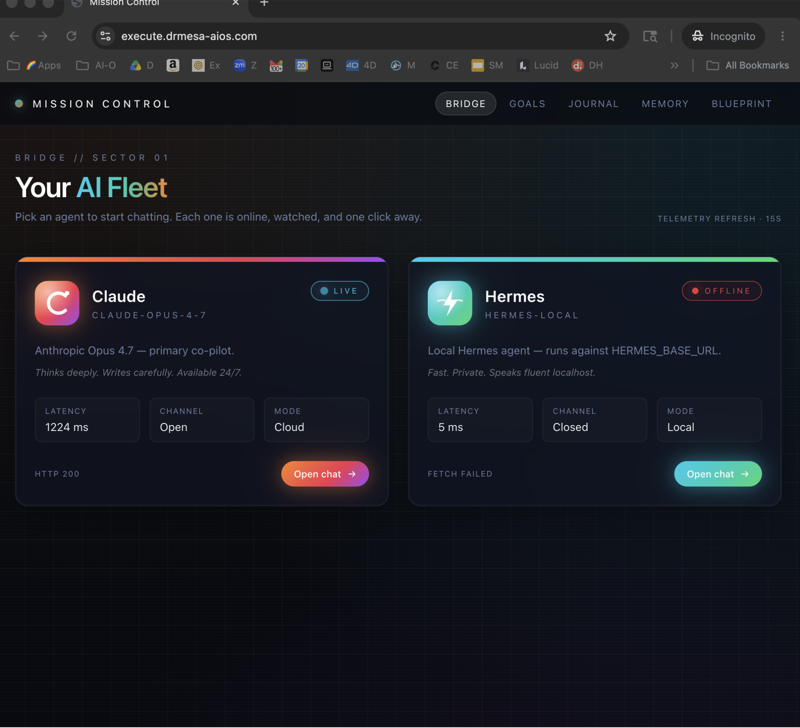
- Hermes Agent HUD UI — the visual layer that makes the Claude+Hermes loop easy to read.
Also On Our Network
- 🌐 Read on bestaiagentcommunity.com
- 🌐 Read on aiprofitboardroom.com
- 🌐 Read on juliangoldieaiautomation.com
- 🌐 Read on aimoneylabjuliangoldie.com
Related Reading
- Hermes AI Agent Framework 2026 — the framework that powers the hands layer of this stack.
- Hermes Agent Installation Guide 2026 — the deep-dive install walkthrough with screenshots.
- Claude Code SEO Agent — Claude Code paired with SEO automation.
- OMI Obsidian — the second-brain layer for context-rich automations.
📺 Video notes + links to the tools 👉
🎥 Learn how I make these videos 👉
🆓 Get a FREE AI Course + Community + 1,000 AI Agents 👉
If you're brand new to AI agents and want the lowest-friction entry point in 2026, the Claude Hermes Agent stack is the one — install the MCP bridge today, run your first hello cron job tonight, and you'll wonder why anyone is still copy-pasting between AI tools manually.