Hermes desktop Mac promises to kill the terminal for good, so I tested it for a full day to see if that's actually true.
The big question everyone asks is simple.
Should you run Hermes in the app, or stick with the terminal?
I'll give you the straight verdict first, then the evidence behind it.
Short answer: for almost everyone, Hermes desktop Mac wins, and here's exactly why.
This is a real comparison, not a sales pitch.
I'll show you where the app wins, where the terminal still has an edge, and who should use which.
🔥 Want my full Hermes desktop Mac comparison pack? Inside the AI Profit Boardroom, I include side-by-side setups, a 30-day roadmap, and 100 Hermes prompts. → Get access here
The Verdict First
For 99% of people, Hermes desktop Mac is the better choice over the terminal.
The terminal is too technical for most people, and you can't easily manage models or APIs in it.
You can with some commands, but most people don't even know those commands exist.
The desktop app puts model management, API switching, memory and settings behind clicks.
That alone makes it the right pick for nearly everyone.
The terminal only wins if you're an advanced user who lives in scripts.
If you want to see how Hermes itself compares to its biggest rival, I cover that in my Hermes vs OpenClaw breakdown.
The Head-To-Head Comparison
Here's the honest side-by-side after a full day of testing on my Mac.
| Feature | Hermes desktop Mac | Terminal |
|---|---|---|
| Setup difficulty | Easy, 7 minutes | Technical commands |
| Model management | Click to switch | Commands only |
| API management | Built-in panel | Manual config |
| Persistent memory | Built-in | DIY |
| Voice | Has settings (buggy) | None |
| File preview | Opens in VS Code | None |
| Skills toggle | Visual on/off | Commands |
| Best for | Almost everyone | Advanced scripters |
The pattern is clear.
Everything the terminal makes painful, the app makes simple.
Where Hermes Desktop Mac Wins
The app keeps all your conversations in one place across multiple platforms.
You can pin sessions, see your history, and start fresh whenever you like.
You can change the context window, the model, and the personality from settings.
You can switch to dark mode and pick a theme like Midnight.
You can manage skills and tools visually, toggling them on and off.
There's even a smart home skill that controls the lights in your rooms.
None of that is realistic in a terminal for a normal person.
The app simply makes running a powerful AI agent feel friendly.
Where The App Still Falls Short
I'm not going to oversell it, because it has real gaps.
You can't preview your files properly, since markdown opens in VS Code instead of inside the app.
The session sync misses things, so not every conversation carried over for me.
The live voice agent asked for permissions but didn't give me a way to grant them, so voice was buggy.
There's no Kanban board to watch sub-agents delegate and complete tasks.
So while it beats the terminal, it isn't the full picture yet.
For smooth voice and a proper Kanban board, I run a full agent operating system, which I cover in my Agent OS Hermes guide.
🔥 Want the exact Mac stack I tested? Inside the AI Profit Boardroom, I've got a full Hermes section with step-by-step video tutorials. Plus weekly coaching calls and 3,600+ members building real automations. → Get access here
Desktop App Vs Agent OS On Mac
There's a third option people forget, and it's a full agent operating system.
Hermes desktop alone is one brilliant agent.
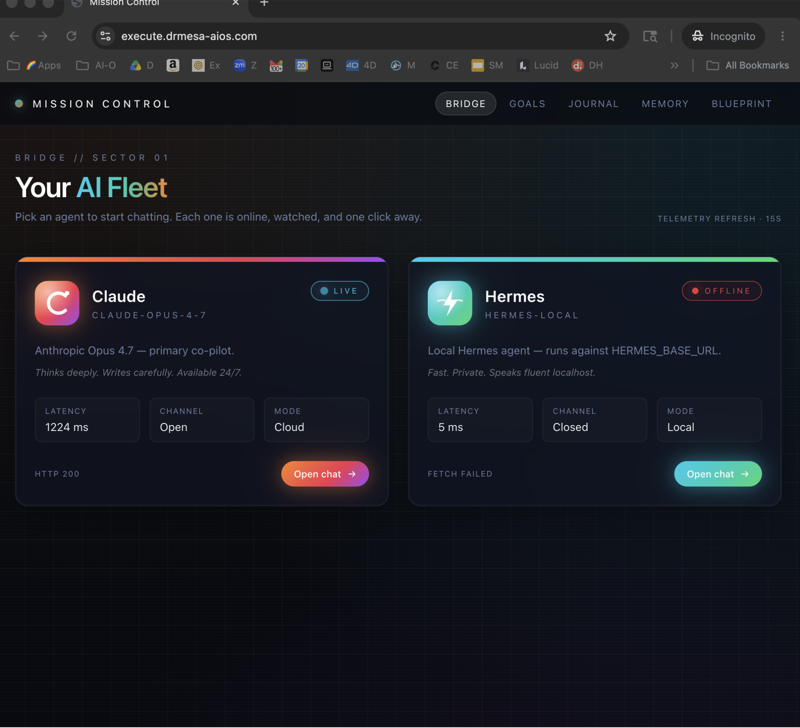
An agent OS is the command centre that runs Hermes plus Claude, OpenClaw, Gemini and more.
Hermes desktop is like a brilliant employee, while an agent OS is the entire company around it.
Inside a full agent OS you can preview your work, run smooth voice chats, and use a Kanban board.
You can also plug in new tools the day they launch, which you can't do in the desktop app.
So the real ladder is terminal, then desktop app, then full agent OS.
| Tier | Tool | Who it's for |
|---|---|---|
| 1 | Terminal | Advanced scripters only |
| 2 | Hermes desktop Mac | Almost everyone starting out |
| 3 | Full Agent OS | Power users running a stack |
Who Should Use Which
If you're brand new, use Hermes desktop Mac and never touch the terminal.
If you tried Hermes before and found it too hard, the Mac app is your second chance, and it's far smoother now.
If you're an advanced user who loves scripting, keep the terminal for edge cases.
If you want previews, smooth voice and multi-agent control, build a full agent OS.
For most readers, the answer is the app.
My Final Take
Hermes desktop Mac is a clear upgrade over the terminal for the vast majority of people.
It's free, it's friendly, and it makes a powerful agent accessible.
It's not flawless, with voice and file preview both needing work.
But the right belief here is simple: if you can text a friend, you can run an AI agent.
And that's exactly what Hermes desktop Mac unlocks.
FAQ: Hermes Desktop Mac vs Terminal
Is Hermes desktop Mac better than the terminal?
For almost everyone, yes.
It puts model management, APIs, memory and settings behind clicks instead of commands.
When should I still use the terminal for Hermes?
Only if you're an advanced user who scripts heavily and needs edge-case control.
Most people never need it.
Does Hermes desktop Mac cost money?
No, the app is free.
You only pay for any model API credits you choose to use.
What does Hermes desktop Mac do better than the terminal?
Conversations in one place, pinned sessions, visual model and API switching, memory, themes and skill toggles.
What's still missing from Hermes desktop Mac?
Proper file preview, reliable voice and a Kanban board, which a full agent operating system provides.
About Julian
I'm Julian Goldie — AI entrepreneur, SEO expert, and founder of the AI Profit Boardroom (3,600+ members). I help business owners scale with AI agents, automation, and SEO.
- 400,000+ YouTube subscribers
- 7-figure AI agency (Goldie Agency)
- Daily training inside the Boardroom
- Author of multiple AI automation playbooks
→ Get my best AI training inside the AI Profit Boardroom
Also On Our Network
- 🌐 Read on bestaiagentcommunity.com
- 🌐 Read on aiprofitboardroom.com
- 🌐 Read on juliangoldieaiautomation.com
- 🌐 Read on aimoneylabjuliangoldie.com
Related Reading
- Hermes vs OpenClaw: Who Wins?
- Agent OS Hermes: The Engine Running My Stack
- Hermes Web UI Walkthrough
📺 Video notes + links to the tools 👉
🎥 Learn how I make these videos 👉
🆓 Get a FREE AI Course + Community + 1,000 AI Agents 👉
Test it yourself and you'll see why Hermes desktop Mac beats the terminal for most people.