The Hermes MCP server is the easiest way for a complete beginner to get two AI agents working together on the same project, and after teaching this setup to dozens of non-technical operators in my community I can promise you that if you can copy and paste, you can do this. This post is the friendly, no-jargon, step-by-step beginner guide.
I will walk through what the Hermes MCP server actually is in plain English, the two setup paths (the easy one and the slightly fancier one), why this matters even if you are not a developer, the four-layer mental model that makes the whole thing click, and the most common beginner mistakes so you can skip them.
🔥 Want my full Hermes MCP server + Codex setup guide? AI Profit Boardroom has the 30-day roadmap, 100 prompts, full setup SOPs, plus guides on Hermes + Claude MCP, Paperclip + Hermes, and more. Daily Q&A + 4 weekly coaching calls. → Get inside
What Is The Hermes MCP Server, In Plain English
The Hermes MCP server is a way to plug Hermes Agent into other AI tools like Codex or Claude so they can use Hermes as a helper. That is the whole concept. You take an agent that already does great work on its own, and you make it available to other agents through a standard plug socket.
The "MCP" part stands for Model Context Protocol. Think of it as the USB-C of the AI world. Before MCP, every connection between AI tools was a different cable. With MCP, there is one universal plug. The Hermes MCP server is what makes Hermes USB-C-compatible.
The reason this matters for beginners is that you do not have to choose between Codex and Hermes anymore. You can run both. Codex builds, Hermes deploys, and you sit there reviewing the output of both. The Hermes MCP server is the cable between them.
Why Beginners Should Care
Most beginners I talk to are stuck at "I have ChatGPT and it gives me good answers but nothing actually gets done." That is the gap the Hermes MCP server closes. ChatGPT is a chat interface. Hermes is a worker. Codex is a builder. When you connect them, the chat-to-action gap disappears.
For a beginner, the simplest way to describe the win is this: you go from typing questions to having things ship. Hermes can publish content for you, deploy websites for you, monitor competitors for you, send messages for you, and run on a schedule whether your laptop is on or off. None of that is true of ChatGPT alone.
The other reason beginners should care is the price. The Hermes MCP server is free and open source. Codex you already pay for if you have a subscription. The combination is the cheapest agent stack with real-world output on the market in 2026.
What You Need Before Starting
You need three things to start, and that is genuinely all. You need Codex installed (you can get this with an OpenAI subscription). You need Hermes Agent installed (one command from the Hermes README — I have a full beginner walkthrough in Hermes Agent Installation Guide 2026 if you want it spelled out). And you need a basic ability to copy and paste text.
That is it. No coding. No config files (unless you choose the fancier path, which is also copy-paste). No command line beyond two short commands you will literally type once.
If you can install software and copy text, you are ready. Stop reading and start setting up.
Setup Path One — The Easy Way
The easy way is the one I recommend every single beginner start with. It takes about two minutes and it gets Hermes running inside Codex with full access to your project folder.
Step one: install Hermes Agent. The Hermes README on GitHub has the one-line install command. Run it once in your terminal. Done.
Step two: open Codex.
Step three: click the terminal toggle in Codex to bring up the integrated terminal. This is the small terminal window inside Codex itself, not a separate terminal app.
Step four: type the word hermes in that integrated terminal and press enter. Hermes is now running inside Codex with access to your project files.
That is the whole easy setup. From this point on, you can use Codex for code (asking it to build, fix, or refactor things) and Hermes for everything else (deploying, publishing, scheduling, monitoring). They share the same project workspace so handoffs are automatic.
The classic beginner flow on the easy setup is build-then-ship. You ask Codex to build a landing page. Codex writes the code. You then ask Hermes to deploy it to Netlify using the built-in Netlify skill. Hermes handles the deploy and tells you when the site is live. You shipped without ever leaving Codex.
Setup Path Two — The Fancier Way
Once you have run the easy setup a few times and want Hermes to be available in every Codex project automatically, you graduate to the fancier setup. The fancier setup registers Hermes as a global MCP server in Codex so you never have to type the hermes command again.
The whole thing is copy-paste. I want to repeat that because most beginners assume "MCP server registration" sounds hard. It is not. You are pasting two documents into Codex and asking Codex to do the work.
Step one: open a new Codex chat.
Step two: add a new project folder. Call it something simple like "Hermes-Codex-MCP". The name does not matter.
Step three: paste the Hermes MCP server documentation into that folder. The documentation is on the Hermes GitHub.
Step four: paste the main Hermes GitHub readme into the same folder.
Step five: type this into Codex: "Set up Hermes MCP with Codex." That is the entire instruction.
Codex will write the config file, register Hermes as a global MCP server in your Codex settings, and verify the connection works. When it finishes, restart Codex once.
After the restart, you can test it by typing something like "do a test run." Codex will initialise Hermes MCP, list the available MCP tools, call the conversations list, and return all your previous Hermes conversations. The first time you see that work, the whole thing clicks.
Watch The Claude-Side Beginner Walkthrough
The Claude Code version of this walkthrough is useful for beginners because it shows the same idea from a different angle. Even if you plan to drive Hermes from Codex, watching the Claude version helps the MCP concept land.
The Four-Layer Stack For Beginners
The mental model that makes this finally click for beginners is the four-layer stack. You only need to understand four words to understand the whole system.
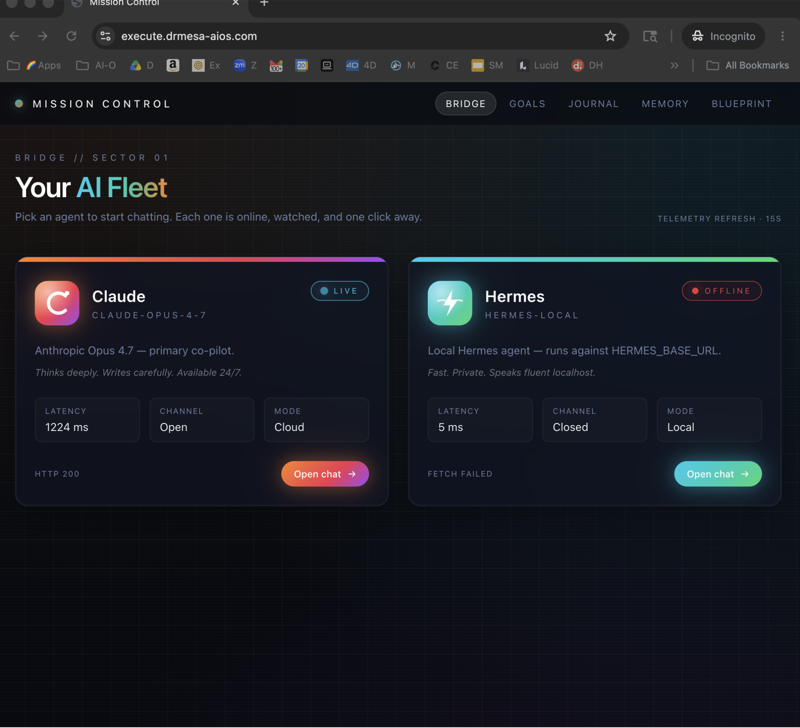
Brain — Hermes Agent. The brain is the smart middle frame that decides what to do, reads files, sends messages, writes code, and takes actions. Hiring Hermes is like hiring a smart employee who never sleeps.
Hands — MCP. The Model Context Protocol is the bridge between the brain and the real world. Without hands, the brain can think but cannot act. With hands, it can touch your files, your hosting, your email, anything.
Builder — Codex. Codex is OpenAI's coding agent. It reads, writes, and fixes code automatically. Wire it to Hermes through MCP and Codex gets superpowers — it can do everything Hermes can on top of everything it already did.
Output — the work that gets shipped. Automated websites, content, deployments, SEO, customer comms. The output layer is what most beginners never reach because the first three layers are not wired together. The Hermes MCP server is the wiring.
When you understand those four words, you understand the whole stack.
Common Beginner Mistakes
The most common mistake I see beginners make is jumping straight to the fancier setup before they have run the easy setup. Do the easy setup first. Get one feature shipped. Then graduate.
The second mistake is treating Hermes like ChatGPT. Hermes is not a chat tool. Hermes is a worker that takes actions on real systems. If you talk to it like ChatGPT, you will under-use it. Give it instructions that produce real-world results, not questions that produce answers.
The third mistake is forgetting that Hermes needs an API key or a model to run. Most beginners assume "free agent" means "no setup at all." You still need to point Hermes at a model — and the good news is that the model can be free. Step 3.5 Flash on Nous Portal is the free option I recommend for beginners.
The fourth mistake is not committing to Git before letting agents touch your project. Always commit before agents do work. If something goes wrong, you can roll back in seconds.
The Token-Economy Hack For Beginners
Once you are running the stack, the trick that nobody tells beginners is to split your token spend between premium and free models. Codex is your premium-brain agent — you pay for it via your subscription and let it use the strongest reasoning model. Hermes is your unlimited-grunt-work agent — you point it at a free API like Step 3.5 Flash so it can run as many tasks as you want without metering.
The result is that you pay once for the brain and the hands are free. Hermes can do hundreds of small tasks per day at zero marginal cost while Codex focuses on the high-leverage decisions where the better model matters.
A useful side tip — if you ever hit your Codex token limit mid-build, just run Hermes in the same Codex terminal and keep working. Hermes uses its own model and tokens, so the work does not stop while Codex's quota resets.
Beginner Use Cases That Actually Work
The use case I recommend every beginner start with is build-and-deploy a single landing page. Codex builds the page in five minutes. Hermes deploys it to Netlify and gives you a live URL. You have shipped your first thing through the stack and you immediately see the value.
The second beginner use case is auto-publishing a blog post. Codex writes the post in markdown. Hermes pushes it to WordPress on a schedule. You never touch the WP admin.
The third beginner use case is competitor monitoring. Hermes runs in the background watching a competitor's blog feed. When a new post drops, Hermes summarises it and sends you the summary. You stay informed without manually checking.
The fourth beginner use case is auto-test-and-deploy. Codex builds a feature, Hermes runs the tests, and if they pass Hermes deploys to staging. If they fail, Hermes sends you the error.
Pick one of these. Get it running this week. Add a second one next week. Compounding starts small.
Beginner Objections Handled
The most common objection from beginners is "I'm not technical enough for this." If you can copy and paste, you are technical enough for this. The fancier setup is literally pasting two documents into Codex and saying "set this up." The agent does the technical work.
The second objection is "I'll set this up later when I have time." AI moves fast and waiting is not free. Six months in AI is the equivalent of about five years in any other space. The cost of waiting is the widening gap between you and people who started today.
The third objection is "isn't this just ChatGPT?" No, it is not. ChatGPT answers questions. Hermes takes actions. ChatGPT is a chat interface, Hermes is a worker. Different category of tool.
The fourth objection is "I don't have anything I want to build." Pick something small. A landing page for a side project. A blog post about something you know. A monitor for a competitor you follow. The point is to ship one thing through the stack so you understand the workflow, not to launch a unicorn on day one.
Comparison Table — Easy Vs Fancier Setup
| Factor | Easy Setup | Fancier Setup |
|---|---|---|
| Time to set up | ~2 minutes | ~10-15 minutes |
| What you do | Type hermes in Codex terminal |
Paste two docs + ask Codex to set up MCP |
| Persistence | Per-project, manual start | Global, auto-loaded everywhere |
| Codex restart | Not needed | Once, after setup |
| Best for | First-time beginners | Beginners running the stack daily |
| Skill required | Copy one command | Copy-paste text |
| Conversation history | Not available to Codex | Fully available to Codex |
Start easy. Move to fancier later. There is no benefit to skipping the easy setup.
Claude + Hermes MCP As The Beginner Alternative
If Codex feels too IDE-heavy for your beginner brain, you can swap the brain for Claude. Same Hermes MCP server, different client. You drive everything from Claude's chat UI without a terminal.
The setup takes about fifteen minutes and the experience is friendlier for content-focused beginners. Full walkthrough at Claude + Hermes Agent. For some beginners, this is genuinely the easier on-ramp.
What To Do Right After Setup
The very first thing to do after either setup is ship one small thing. Do not read documentation. Do not plan a megaproject. Pick something tiny — a landing page, a one-pager, a deployed test site — and run it through the stack from build to deploy. The moment you ship one thing, the stack stops being theoretical and starts being real.
The second thing to do is commit it to Git. Always. This habit is non-negotiable and the first time something breaks you will be glad you did.
The third thing to do is schedule a second Hermes task to run in the background. A daily competitor check, a weekly site audit, anything. Once Hermes is running scheduled work, you start experiencing the 24/7 leverage that this stack is built for.
🚀 Are you a marketing agency? Want SEO + AI combined? Book a free strategy session with my 7-figure SEO agency Goldie Agency (50-person team). → Book free session
FAQ — How To Set Up Hermes MCP Server
Do I need to be a developer to set this up?
No. The easy setup is one install command and one hermes command in the Codex terminal. The fancier setup is copy-pasting two documents into Codex. The agent writes the config — you do not.
Is the Hermes MCP server free?
Yes. The Hermes MCP server is free and open source. You only pay for Codex if you choose to (you may already have it) and the model you point Hermes at, which can also be free.
Which setup should I start with?
The easy one. Type hermes in the Codex integrated terminal and you are done. Graduate to the fancier setup once you are running the easy one daily.
What can I actually do with this on day one?
Build a landing page in Codex and deploy it to Netlify with Hermes. That is the cleanest first ship for beginners and it takes well under an hour end-to-end.
Will it really work without me being technical?
Yes, if you start with the easy setup. The fancier setup is also beginner-friendly because the agent does the technical work — you just paste two documents.
Can I run this with Claude instead of Codex?
Yes. Hermes MCP works with any compatible client. The Claude version is in Claude + Hermes Agent and is often easier for content-focused beginners.
What if I run out of Codex tokens?
Run Hermes in the same Codex terminal. Hermes uses its own model and tokens, so you keep working while Codex's quota resets.
Should I upgrade to AI Profit Boardroom for help?
If you want the full beginner playbook, the 30-day roadmap, the 100 prompts, and weekly live coaching where I walk through this stack on screen-share, yes — AI Profit Boardroom is built exactly for this audience.
Latest Updates
- Hermes Agent Installation Guide 2026 — install Hermes step-by-step if you have not yet.
- Hermes Agent HUD UI — the visual control panel for monitoring Hermes.
- Sonnet 4.8 Review — the model I default to as the brain layer.
Also On Our Network
- 🌐 Read on bestaiagentcommunity.com
- 🌐 Read on aiprofitboardroom.com
- 🌐 Read on juliangoldieaiautomation.com
- 🌐 Read on aimoneylabjuliangoldie.com
Related Reading
- Hermes AI Agent Framework 2026 — the framework behind the MCP server.
- Hermes Agent Goals — autonomous loops worth running once you are comfortable.
- Hermes Computer Use — desktop control as an upgrade path.
- Claude + Hermes Agent — the Claude-side version of the MCP setup.
- Hermes SEO — the SEO automation flow built on this stack.
📺 Video notes + links to the tools 👉
🎥 Learn how I make these videos 👉
🆓 Get a FREE AI Course + Community + 1,000 AI Agents 👉
For complete beginners stepping into the AI agent world in 2026, the Hermes MCP server is the single easiest way to feel real leverage from day one — install it today, ship one thing this week, and you will not look at AI tools the same way after you run the Hermes MCP server.