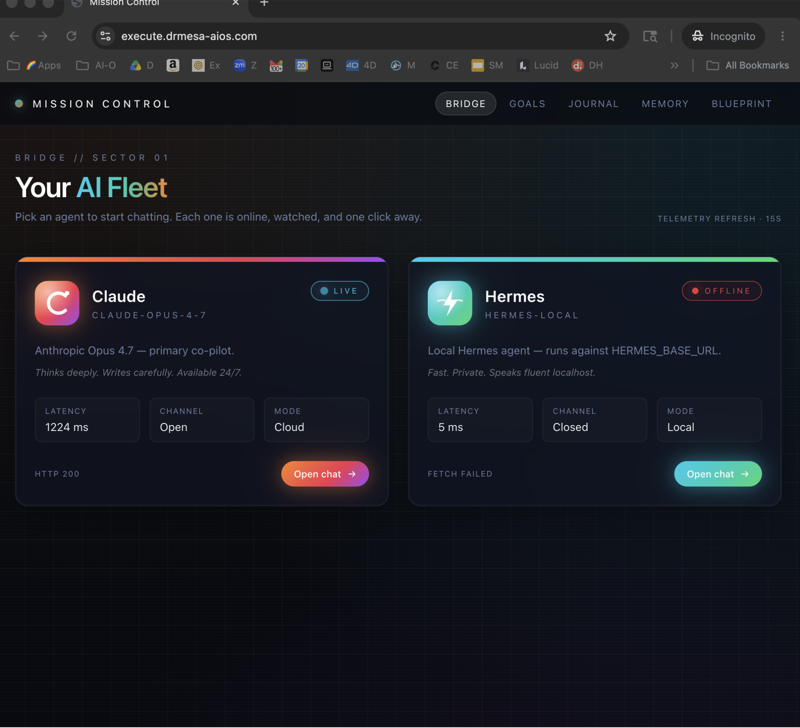
OpenClaw Aion UI isn't just for OpenClaw — it's a multi-agent dashboard that runs Hermes, OpenClaw, Claude Code, and 7+ other CLIs in one place. If you've been juggling separate windows for OpenClaw, Hermes, and Claude Code, this post is the upgrade you didn't know you needed.
Aion UI manages all of them from one dashboard. I'll cover what CLIs Aion UI supports, how to set up multi-agent teams, real workflows you can build, and the mistakes to avoid in your first week.
What OpenClaw Aion UI Supports
Out of the box, Aion UI works with OpenClaw, Hermes, Open Code, Kim CLI, Codex, Quen, Claude, Gemini, Aon CLI, and Nanobot. That's 10+ AI CLIs in one dashboard, which is the unique value proposition versus single-CLI tools like ClawX OpenClaw.
Why Multi-Agent Matters
Single-agent workflows are fine for simple tasks, but multi-agent is where real automation lives.
You can split a complex task across specialised agents: a research agent collects data, a writer agent drafts content, a code agent handles dev work, and a QA agent reviews output. Each agent uses the right model for its job, and Aion UI lets all of them work side by side. This is the same pattern as Hermes Agent Swarm but extended across multiple CLIs.
Setting Up A Multi-Agent Team In OpenClaw Aion UI
Three steps to a working team.
1 — Make sure each CLI is installed locally
You need OpenClaw, Hermes, or whichever CLIs you want actually installed on your machine first. Aion UI doesn't install the CLIs — it manages them. If you don't have them, follow Build Your Own OpenClaw and Ollama Hermes.
2 — Connect them in Aion UI
In Aion UI's settings, add the OpenClaw provider, add the Hermes provider, and add Claude Code if you have it. Aion UI auto-detects when each CLI is running.
3 — Create the team
In the Teams section, click "Create team", set a team leader (e.g. OpenClaw or Claude Code), add agents to the team, and configure each agent to use a different CLI. Now they can collaborate.
🔥 Want my full multi-agent Aion UI playbook? Inside the AI Profit Boardroom, I share my exact multi-agent configs, team setups, and workflows. Plus a 6-hour OpenClaw course, 2-hour Hermes course, and weekly live coaching where you can share your screen for help. 3,000+ members. → Get the playbook
Real Workflow 1 — Content Generation
The classic multi-agent workflow.
The setup uses a research agent on Hermes with the web search skill, a writer agent on OpenClaw with the content skill, and a QA agent on Claude Code for review.
The flow goes like this: I give the team a keyword, the research agent (Hermes) gathers data, the writer agent (OpenClaw) drafts the article, and the QA agent (Claude Code) reviews and suggests edits. Each agent uses the model best suited for its job.
Real Workflow 2 — Code Project
For developers who want a real multi-agent code workflow.
The setup uses an architect agent on Claude Code (best at planning), an implementation agent on Codex (best at writing code), and a test agent on OpenClaw with the terminal skill (runs the tests).
The flow is: describe the feature, the architect agent designs the approach, the implementation agent writes the code, and the test agent runs the tests and reports back. Multi-CLI lets each agent specialise in what it's actually best at.
Real Workflow 3 — Daily Ops
The compounding workflow that runs in the background.
The setup uses a monitor agent on OpenClaw on a schedule (watches RSS feeds, dashboards), a communicator agent on Hermes connected to Telegram (handles inbound messages), and a drafter agent on Claude Code (drafts replies and content).
The flow is: the monitor agent runs every hour, sends alerts to the communicator agent, and if something needs a reply the drafter agent writes it for the communicator agent to post. Hands-off ops loop.
OpenClaw Aion UI Phone Control Across All Agents
Aion UI's phone access works across all connected CLIs. You can trigger a Hermes task from your phone, switch to an OpenClaw agent to check status, approve a Claude Code action, and do it all from one mobile interface.
For anyone running ops on the go, this is the killer feature.
Models And Cost Per Agent
Don't put every agent on the same model. Match the model to the role.
The research agent should run a long-context cloud model (Kim K2.5 or DeepSeek). The writer agent should run a creative cloud model. The code agent should run Qwen 3.6 (local) or Claude. The QA agent should run a small fast cloud model.
Aion UI lets you switch models per agent in seconds, which is what makes the per-agent specialisation viable.
Voice Input For Multi-Agent
Aion UI supports voice input. Speak your task and it transcribes and routes to the right agent (or you pick the agent yourself).
Useful for hands-free ops or rapid prototyping.
Four Common Multi-Agent Mistakes
These mistakes cause most multi-agent setups to fail.
1. Same model on every agent. Defeats the point. Use different models for different roles.
2. Vague agent system prompts. Each agent needs ONE clear job. Don't let any agent overlap with another.
3. No handoff rules. Without explicit handoff lines, agents drift. Tell each agent how to hand off (e.g. "Research complete. @Writer — draft based on the points above.")
4. Trying to manage everything in chat. Use Aion UI's task scheduling for recurring work rather than chat-driven triggers.
Skills That Work Across Agents
Aion UI's skills marketplace skills work across the connected CLIs. Web search, browser automation, Tavly, file operations, and memory profiles all install once and work anywhere.
Install once, use anywhere is the entire point.
A Typical Multi-Agent Day
Here's what a typical day looks like for me. At 7 AM the overnight monitor agent flags interesting news. By 7:15 the research agent pulls deeper sources. By 8 AM the writer agent drafts content based on research. By 9 AM the QA agent reviews drafts. By 10 AM I approve final content for publishing.
Most of it runs in the background. I check in, approve, and move on. That's the multi-agent compound effect.
When Multi-Agent Is Overkill
Be honest about when single-agent is the right choice.
Single agent is fine if the task is small, it's a one-off, or you're prototyping. Multi-agent is for quality-critical output, when different stages need different skills, or when you want speed via parallel execution.
🚀 Want my full multi-agent automation system? The AI Profit Boardroom has my full multi-agent playbook, OpenClaw 6-hour course, 2-hour Hermes course, weekly live coaching, and 3,000+ members. → Join here
FAQ — OpenClaw Aion UI Multi-Agent
Can I run OpenClaw and Hermes simultaneously?
Yes. That's the main use case.
How many agents can I run at once?
Hardware-dependent. I run 4 to 5 daily without issues.
Do all agents need to be installed locally?
Yes. Aion UI manages them but doesn't install them.
Can agents from different CLIs talk to each other?
Yes. Aion UI handles the routing.
Will multi-agent work on a low-spec laptop?
It's limited. If you're under 16GB RAM, stick to 2 to 3 agents.
Which CLI should I add first?
OpenClaw or Hermes. Both have strong multi-agent support.
Is voice input reliable?
For most prompts, yes. For technical jargon, sometimes the transcription is off.
Related Reading
- OpenClaw Aion UI — install walkthrough.
- Hermes Agent Swarm — Hermes-side multi-agent.
- ClawX OpenClaw — OpenClaw-only alternative.
📺 Video notes + links to the tools 👉
🎥 Learn how I make these videos 👉
🆓 Get a FREE AI Course + Community + 1,000 AI Agents 👉
OpenClaw Aion UI is the multi-agent dashboard that finally makes Hermes + OpenClaw + Claude Code workflows practical.