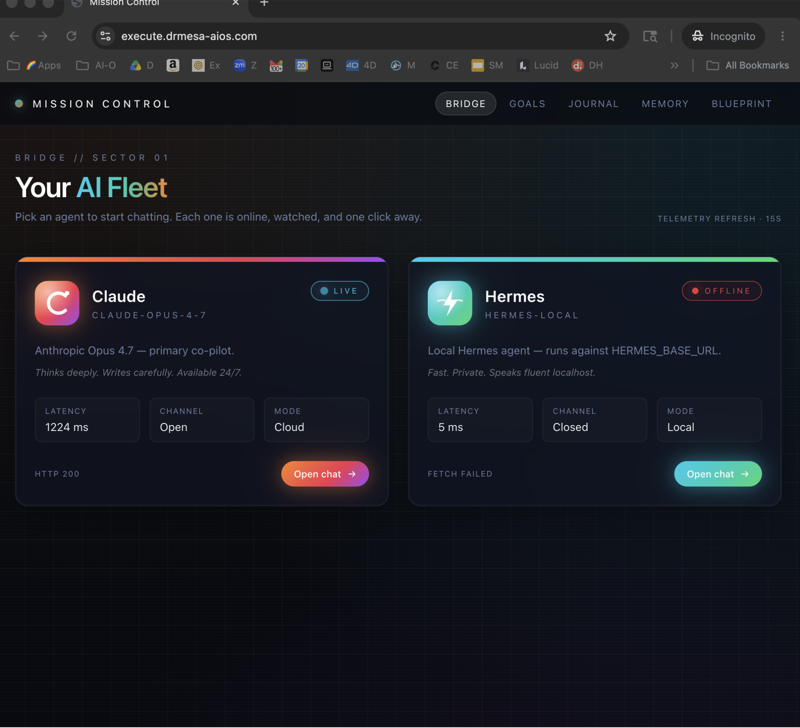
Hermes Agent OS is the simplest way I've found to go from "I use AI tools" to "I run an AI operating system", and the build is way easier than most beginners assume. I built mine in roughly one hour with Claude Desktop, it runs locally on my Mac, and it now drives Claude, Hermes and OpenClaw as one connected team from a single dashboard.
This is the beginner-friendly walk-through I wish I'd had when I started. I'll cover what Agent OS actually is in plain English, the dashboard tour, exactly how I built mine in one Claude prompt, the 4-layer Goldie Mission Stack, and how to grab the full bonus pack inside AI Profit Boardroom.
🔥 Get the Hermes Agent OS as a free bonus AI Profit Boardroom members get the Agent OS zip file, 100 prompts, 30-day roadmap, plus Hermes Agent + Claude OS launch kit + 27 other launch kits. → Get inside
What Hermes Agent OS Is In Plain English
Hermes Agent OS is a local dashboard that lets you run every AI agent on your machine from one place. Think of it as the control panel for Claude, Hermes, OpenClaw and any other AI tool you use. Instead of bouncing between ten browser tabs, you open Agent OS and everything is there in front of you.
It also adds shared memory between agents so they all know about your goals, your business and your notes. That means the second agent never has to be re-briefed on the first agent's work. The system remembers everything for you.
The simplest way to think about it is this. Using AI is like having a hammer. Running an AI operating system is like running a construction company. Beginners usually start with the hammer. Agent OS gets you to the construction company without years of learning curve.
The Hermes Agent OS Mission Control Tour For Beginners
When you open Agent OS you see one clean screen with three areas. The left rail is your list of agents with live status indicators — Claude, Hermes, OpenClaw, plus any custom agent you add later. The middle is where you chat with whichever agent you've clicked on. The right rail is your brain — goals, journal, and memory search.
Every conversation you have with any agent gets auto-saved to your local memory layer. That means three weeks from now you can search "what did Claude say about my onboarding email" and get the exact thread back in one click. No more lost context.
Click into any agent and you open its control room. You see its API keys, its providers, its session history, the skills and plugins it has access to, its Kanban-style task list, and a built-in analytics panel showing how many sessions you've run, how many tool calls fired, how many tokens you've used, and what time of day you actually do your best work. That's a level of insight beginners usually never see.
How I Built Mine In Roughly One Hour With Claude Desktop
This is the part beginners always get wrong — they think you need to write code. You don't. You just need to describe what you want and let Claude build it. The whole build took about an hour in one Claude Desktop session.
The prompt I used was simple. I asked Claude to "create a beautiful operating system hosted locally for managing Claude for a website connected to Claude, like a beautiful mission control dashboard, and then allow me to control my OpenClaw, my Hermes, and any other agents in separate systems inside the dashboard."
Then I pasted in the documentation from the Hermes GitHub and the OpenClaw GitHub so Claude understood the agent APIs it needed to wire into. That's the whole secret — give Claude the docs and the clear ask, and it does the heavy lifting.
Claude scaffolded the whole thing in Next.js and Tailwind, fully locally hosted on my Mac. On first pass I had the dashboard, the chat panels, the goals tracker, the journal, the memory layer, and the per-agent control rooms working. By the end of the session I had voice input via the microphone added too. Most beginners overthink this. You can ship V1 tonight.
The Goldie Mission Stack — 4 Layers Beginners Should Know
Once Agent OS is live you need a mental model for how everything fits. I call it the Goldie Mission Stack. Most beginners stop at the first two layers and never feel the real benefit. The unlock is layers three and four.
Layer 1 — Intelligence (Claude / Claude Code)
Claude is the brain. It does the thinking, planning and decision-making. Claude is wired into Agent OS as a live connection with full tool access, MCP support, and the ability to write and run code on your machine. Treat it as the CEO of your stack.
Layer 2 — Execution (OpenClaw)
OpenClaw is the local agent gateway — basically the router for your agents. It moves tasks between agents, manages sessions, and handles multi-agent coordination. Without it, your agents drift apart. With it, they work as one team. Beginners often skip this and wonder why things feel chaotic.
Layer 3 — Research (Hermes)
Hermes runs the actual work. Tool calls, Kanban task lists, skills and plugins, scheduled multi-step workflows, and research tasks like competitor analysis. While Claude thinks and OpenClaw routes, Hermes ships. Beginner setup is in Hermes Agent Installation Guide 2026.
Layer 4 — Self (Obsidian Vault + OMI)
This is the layer beginners skip the most, and it's the one that changes everything. OMI records your screen and microphone all day, takes notes on what you're doing, and exports it to your Obsidian vault. Your agents then pull from that vault to give you advice that's personal to you. See OMI Obsidian for the beginner setup.
Why The Self Layer Is The Beginner Cheat Code
The Self Layer is the difference between an agent giving you generic advice and an agent giving you advice that knows your goals, your customers and your projects. It has three components inside Agent OS that compound every day.
Goals are tracked with progress bars so every agent knows what you're working towards. Journal entries — voice or text — go into the vault daily so agents always know what you're focused on this week. Memory means every chat with any agent is auto-saved and vault-searchable, which means the system never forgets a thing you've ever told it.
Day one this is good. Day thirty this is wild. The output compounds because the system knows more about you and your business every single day. Beginners chase better prompts. They should be building a deeper Self Layer instead.
Why Local-First Is Better For Beginners
Agent OS lives on your machine, and for a beginner that's actually the simpler path. Local-first beats cloud for three reasons.
First, your data stays on your machine. As a beginner you're going to put real notes, real revenue numbers and real journal entries into this system. That belongs on your hardware, not someone else's cloud database.
Second, it's faster. There's no waiting for a cloud provider to respond every time you switch agents or pull a note. Everything is instant because everything is local.
Third, the setup is cleaner. Local files and local APIs are much easier for beginners than juggling five different cloud platforms with five different login flows. You skip a whole class of "why isn't this connecting" problems.
A Beginner-Friendly Real Example
Here's a real example from this week. I opened Agent OS, clicked into Hermes, and typed "based on my Obsidian vault, give me some ideas on what I should automate today". I hit enter.
Hermes pulled context from my Goldie Agency notes, my AIPB community notes, and my current Hermes build work. It came back with a personalised list of automations specific to my business — not generic AI ideas from a training set, but actual quick wins tied to projects already on my desk. "Quick wins for you as well — here's where automation would move the needle today" was how it framed the output.
That's what beginners miss. Without the Self Layer, the same prompt would have given a generic listicle. With Agent OS and the Self Layer, it gave a strategic brief tailored to my actual business. That's the gap worth crossing as early as possible.
Getting Agent OS As An AIPB Bonus
If you're a complete beginner and don't want to scaffold this from scratch, I package the whole thing as a bonus for AIPB members. You get the Agent OS zip file ready to install, 100 prompts to drive it, and a 30-day roadmap that walks you from install to the full Goldie Mission Stack live on your machine.
That sits inside a stack of 27+ launch kits — Hermes Agent + Claude OS launch kit, 10 Minute Claude Profit Kit, Hermes Quick Deploy Kit, Hermes Money Machine, Hermes 30 Day Roadmap, AI Triple Threat Money Blueprint, plus the Hermes Agent OS 10 revenue builds pack. There's enough in there to keep a beginner busy for months.
Membership is $69/month locked forever with a 7-day refund and a 30-day ROI guarantee. The twin guarantee makes it zero-risk to try.
Beginner Comparison — Browser Tabs Vs Agent OS
| Beginner Question | Browser Tabs Of AI Tools | Hermes Agent OS |
|---|---|---|
| Memory across sessions | None | Vault-backed memory |
| Multi-agent coordination | Manual copy-paste | OpenClaw routing |
| Goal tracking | None | Built-in with progress |
| Daily journal | None | Built-in + voice |
| Local-first | No | Yes |
| Built-in analytics | None | Sessions, tokens, peak hours |
| Personalised output | Generic | Pulls from your vault |
| Compounds over time | No | Yes — day 30 is wild |
| Build time | N/A | One Claude Desktop session |
| Beginner-friendly | Familiar but limited | One screen, all agents |
The right-hand column is why beginners should skip straight to Agent OS.
🚀 Want hands-on coaching to build your own Agent OS? AIPB has 4 weekly live coaching calls with me + daily Q&A with custom video answers. → Join here
FAQ — How To Build Hermes Agent OS
How long does it take a beginner to build?
About one hour in Claude Desktop with the right prompt and the Hermes + OpenClaw docs pasted in. V1 ships tonight.
Do I need to know how to code?
No. You describe what you want in plain English, paste in the docs, and Claude scaffolds it in Next.js and Tailwind on first pass.
Why local-first for beginners?
Privacy, speed, and a cleaner setup. Local files and local APIs are easier than juggling five different cloud platforms.
How is Agent OS different from Hermes?
Hermes is one of the agents inside Agent OS. Agent OS is the dashboard, memory layer and coordination shell sitting above all the agents — see Agentic AI OS for the wider picture.
Can I add other AI tools later?
Yes — OpenClaw routes to any agent. OpenAI, Gemini, local models and vertical AI tools all wire in alongside Claude and Hermes.
What about the HUD overlay on top of my desktop?
Pair Agent OS with the Hermes Agent HUD UI for a heads-up overlay so you can drive agents without opening the dashboard.
What if I want MCP tool access?
Claude inside Agent OS supports MCPs natively — see Hermes MCP Server for the server side of the beginner setup.
Should I upgrade to AI Profit Boardroom?
If you want the prebuilt zip file, the 100 prompts, the 30-day roadmap, the 27 other launch kits and the weekly live coaching, yes — the twin guarantee makes it zero-risk to try.
Latest Updates
- Hermes Agent Goals (NEW Persistent Update FREE) — beginner-friendly goal loops that plug into Agent OS.
- Hermes Computer Use — the desktop-control layer worth pairing with Agent OS.
- Claude Hermes Agent — the Claude side of the Intelligence Layer.
Further Reading On Agent OS Guide
For deeper walkthroughs on the topics in this article, the Agent OS Guide library has these worth bookmarking.
- Agent OS Guide — the full library of agent OS walkthroughs in one place.
- Hermes Agent OS Q&A — the most asked Hermes Agent OS questions answered in one page.
- Hermes SEO Agent OS — how Hermes plugs into a real SEO agent OS workflow.
- NotebookLM Agent OS — the research half of the Hermes stack done right.
Also On Our Network
- 🌐 Read on bestaiagentcommunity.com
- 🌐 Read on aiprofitboardroom.com
- 🌐 Read on juliangoldieaiautomation.com
- 🌐 Read on aimoneylabjuliangoldie.com
Related Reading
- Hermes AI Agent Framework 2026 — the framework behind the Hermes layer.
- Hermes Agent Installation Guide 2026 — install Hermes first, then layer Agent OS on top.
- OMI Obsidian — the Self Layer setup in detail.
- Agentic AI OS — the broader operating system thesis for beginners.
📺 Video notes + links to the tools 👉
🎥 Learn how I make these videos 👉
🆓 Get a FREE AI Course + Community + 1,000 AI Agents 👉
Hermes Agent OS is the beginner-friendly mission control that turns scattered AI tools into one connected system — build it this week, run the Goldie Mission Stack, and you'll never go back to ten browser tabs.